


Reuters/Tokyo
Japan scrambled fighter jets to prevent possible incursions by Chinese planes a record high number of times for the July-September period, the defence ministry said yesterday, with Tokyo and Beijing at loggerheads over disputed islets.
Japan jets scrambled 117 times, up from 103 in the same period of last year, although it was lower than the all-time high of 164 times recorded in the final quarter of 2014.
It was not immediately clear why the number of scrambles rose and the ministry did not offer an explanation.
Japan has long been mired in a territorial dispute with China over a group of tiny, uninhabited East China Sea islands, called the Senkaku in Japan and Diaoyu in China.
Patrol ships and fighter jets from Asia’s two biggest economies have been shadowing each other on and off near the islets, raising fears that a confrontation could result in a clash.
Japanese prime minister Shinzo Abe and China’s top diplomat, Yang Jiechi, last week agreed to push for early adoption of a communication mechanism, now in the works, to avert misunderstandings between their militaries.
Sino-Japanese ties, also plagued by the two countries’ wartime past, concerns over Tokyo’s bolder security stance and Beijing’s increasing military assertiveness, have thawed a little in the last year.
Scrambles against Russian planes fell 43% from a year earlier to 51 times in July-September, helping bring down the number of Japan’s overall scrambles in the three-month period by 12% to 170.
Russian bombers and patrol planes often fly close to Japan’s northern air space close to Hokkaido and four smaller islands claimed by both countries.
Japan said yesterday that prime minister Shinzo Abe was acting in a private capacity when he sent a ritual offering to a shrine for war dead, seen as a symbol of Japan’s past militarism by many in Asia, but China said he was wrong to do so.
Abe on Saturday sent a “masakaki” ceremonial tree to mark the annual autumn festival at Tokyo’s Yasukuni Shrine, where war criminals are enshrined along with the war dead.
“I am aware of media reports that prime minister Abe sent masakaki, but the action was done as an private individual, so I don’t think it’s something the government should comment on,” Japanese government spokesman Yoshihide Suga said. “I think it’s a globally common act to give prayers to those who gave their lives for their country.”
Chinese Foreign Ministry spokeswoman Hua Chunying noted the shrine also honours war criminals. Fourteen Japanese leaders convicted as war criminals by an Allied tribunal after World War Two are also enshrined at Yasukuni.
“China has consistently resolutely opposed these mistaken acts by important Japanese politicians. We urge Japan to face up to and deeply reflect on the history of militarism,” Hua told a daily news briefing.
Abe’s offering came as China and South Korea, where memories of Japanese occupation and colonialism before and during World War Two persist, are arranging a trilateral summit with Japan, the first leaders’ meeting since May 2012.
Japanese media said the talks would be on November 1 in Seoul.
A December 2013 visit by Abe to Yasukuni angered China and South Korea. Recently both Beijing and Seoul have signalled a desire for improved relations with their neighbour.
Last week, Japanese media said Abe invited Chinese president Xi Jinping to visit Japan around spring next year, via a letter delivered by the head of the junior party in Japan’s ruling coalition.
Sino-Japanese ties, plagued by their wartime past, concerns over Tokyo’s bolder security stance, a maritime territorial dispute and Beijing’s increasing military assertiveness, have thawed a little in the last year.
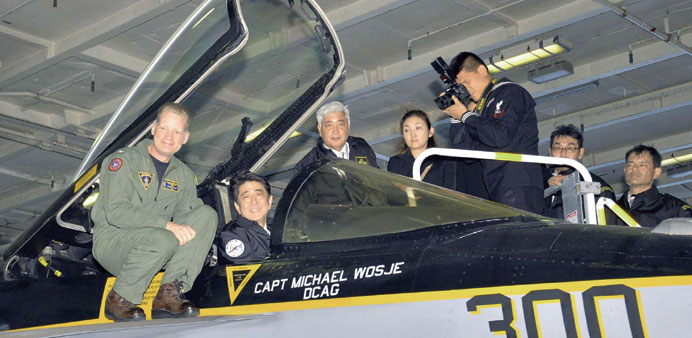
Prime minister Shinzo Abe in an F/A-18 Hornet fighter jet as he visits the USS Ronald Reagan, a Nimitz-class nuclear-powered super carrier, at Sagami