Agencies/Cairo
Hundreds of thousands of Egyptians massed yesterday in Cairo’s now-iconic Tahrir Square to celebrate the fall of strongman Hosni Mubarak and to pressure their new military rulers to deliver reform.

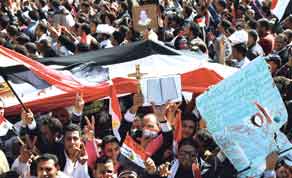
An Egyptian man holds up a cross in one hand and the Holy Qur’an in another while others wave national flags as hundreds of thousands of Egyptians gathered yesterday in Cairo’s landmark Tahrir Square to celebrate the ouster of president Hosni Mubarak
Influential Muslim cleric Yusuf al-Qaradawi addressed the host of people during Friday prayers, calling on Arab leaders to listen to their people, to cheers from a crowd with a large contingent of Islamist activists.
Protesters performed their prayers in massed ranks, with tanks surrounding the square and a light security presence.
Before the crowds swelled for the Friday prayer, a military band in full dress uniform was playing patriotic music to the cheers of the adoring crowd.
“You are Egyptian - raise your head high,” read one banner amid a sea of red, white and black national flags stretching across the square and far down the capital’s streets.
Horse carriages were back on the streets and their owners have put little Egyptian flag bandannas on their feet.
The end of noon prayers was the cue for a party set to last long into the night. Families sang and danced to pop music that blared from boats bobbing in the Nile, others danced and banged drums on the river’s banks.
Young people had painted their faces in the national colours and sang the national anthem. One woman wore an “I love Egypt” t-shirt over her traditional abaya.
Some dressed up as Egypt’s ancient pharaohs, others released red, white and black balloons that drifted off over the landmark Egyptian Museum.
Some took pictures of the scene near the torched shell of Mubarak’s ruling party building or alongside tanks with their families surrounded by beaming young soldiers. Vendors sold flags, popcorn, soda and snacks to people as they arrived, others wore badges with images of protesters who died in the uprising.
“Photos of the martyrs, just one pound, photos of the martyrs, just one pound,” cried one vendor in the crowd.
Gone was the atmosphere of menace that hung over the anti-Mubarak protests, as military police prayed alongside citizens in traditional “galabeya” robes or modern Western dress.
The army tanks guarding Cairo’s streets were covered in national flags. Small children clambered over armoured vehicles.
The sheer scale of the demonstration, not seen since the funeral of revered Egyptian singer Umm Kalthoum in 1975, will remind the army-led interim government of its promise to move quickly to democratic, civilian rule.
“The people want the purification of the regime,” chanted the crowd in Tahrir Square, and “Hosni left his palace, so how can his allies run the country?”
One banner read: “For the sake of stability: the police and the people hand in hand against thuggery”.
A memorial was set up with photographs of some of the protesters who died, surrounded by flowers and Egyptian flags.
Amid the celebrations, anger at high-level corruption under Mubarak still runs high.
One man held aloft a poster demanding the resignation of Prime Minister Ahmed Shafiq’s interim cabinet including Oil Minister Sameh Fahmy, Foreign Minister Ahmed Aboul Gheit and “the rest of his gang”.
Fahmy and Aboul Gheit kept their posts after the uprising.
Others fearful for the country’s suffering tourism industry marched from the state television building towards Tahrir holding banners in foreign languages to support tourism.
Some dragged along an enormous model pyramid and one colourful poster showed people diving in the Red Sea with the words “Hosni is out, Egypt is fun”. A banner held by 10 people read: “Visit the land of peace,” “Help us rebuild Egypt”.
Twenty girls standing on a tank sang a song from a 1970s musical: “Egypt our country is a land for tourists, the foreigners come to have fun”.
“We need the tourists to come back. Egypt is free, the fight is far from over but we are ready to rebuild and we need the economy to get rolling again,” said hotel worker Mohamed, 35.
Activists ratcheted up pressure on the Supreme Council of the Armed Forces, that took power when Mubarak stepped down on February 11, by calling a march in Cairo to commemorate their dead and press for the release of detainees.
The Coalition of the Revolution Youth, which groups pro-democracy movements that helped launch the revolt, called for the gathering to “remember the martyrs of freedom and dignity and justice.”
At least 365 people were killed and 5,500 injured in the protests leading up to Mubarak’s downfall, according to the health ministry.
The coalition has vowed to keep up the pressure to ensure the rest of its political demands are met, including the “immediate release of all detainees”, it said in statement posted on Facebook.
Hundreds of people went missing during the protests, rights groups say, blaming the army, which they have also accused of torture.
Gamal Eid, a lawyer who heads the Arabic Network for Human Rights Information, said: “There are hundreds of detained, but information on their numbers is still not complete ... The army was holding detainees.”
The coalition of activists is also calling for “a speedy replacement of the current caretaker cabinet by a government of technocrats” that are not seen as corrupt, it said.
Pro-democracy activists are also seeking a lifting of the decades-old emergency law and support for the pay strikes that have surged around the country.
“We are going today to commemorate the martyrs and in doing so we are awaiting justice,” said Mohamed Waked, a protest organiser.
“If those detained during the protests are not released, let alone the older political prisoners, it would be a bad sign. It would show the army is not sincere about political reforms.”
In Tahrir Square, taxi driver Farag Radwan, who took the day off to celebrate, said he was following other revolts in the Arab world on television. “Why can’t we be united like Europe?” he said. “The problem is with the presidents, not the people.”
Activists, who are also calling for a complete dismantling of Mubarak’s regime, welcomed the arrest of reviled former interior minister Habib al-Adly, whose security forces were given wide powers of arrest under the emergency law. Adly was arrested on Thursday on suspicion of money laundering and ordered held for 15 days.
And prosecutors ordered former tourism minister Zuheir Garana, former housing minister Ahmed al-Maghrabi and businessman Ahmad Ezz also to be held for 15 days “to assist in an investigation,” a judicial source said.