


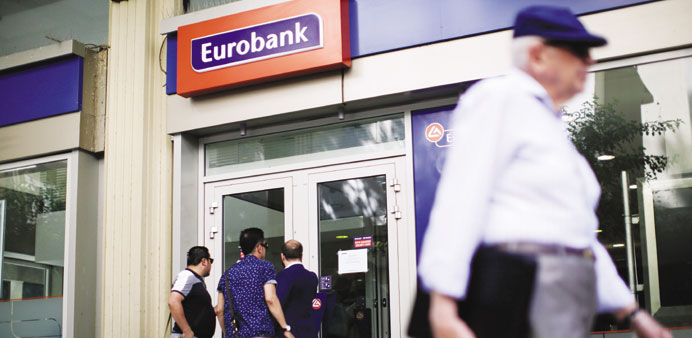
Customers wait to enter a Eurobank Ergasias bank branch in Athens. Eurobank Ergasias and Alpha Bank are considering asking investors to swap notes for shares, sources said.
Bloomberg/London
Greek banks met a group of bondholders last week and discussed the possibility of debt swaps to help repair their balance sheets, according to two people familiar with the matter.
Eurobank Ergasias and Alpha Bank are considering asking investors to swap notes for shares, said the people who asked not to be identified because the talks were private. National Bank of Greece, which also attended the meeting in Athens, may also consider a bond swap, depending on the price in its sale of Turkish unit Finansbank, the people said.
Bonds of the lenders and Piraeus Bank, which has announced the terms for an exchange, jumped as investors saw a chance of swapping notes that were quoted as low as 43¢ on the euro this week for shares in recapitalized banks. As much as €25bn ($28bn) from Greece’s latest bailout has been earmarked to backstop recapitalisations, and euro-area finance ministers said in August that bondholders may have to take losses before public money is used.
“The banks and the regulators would like this sort of arrangement because it’s an easier cleanup and reduces the risk of litigation if a hard bail-in process were imposed,” said Jakub Lichwa, a financial credit analyst at Daiwa Capital Markets in London. Bond buyers may have a “good chance” of profiting if swaps happen this year, because of the Greek banks’ very low price-to-book ratios, he said.
Spokesmen for Eurobank and Alpha Bank declined to comment. National Bank of Greece spokesman Dimitris Spyropoulos said the lender has no immediate plans to pursue a bond exchange.
Alpha Bank is considering targeting holders of more than €1bn of notes, the people said. The lender and Eurobank have a combined €1.94bn of outstanding senior and junior unsecured bonds.
Piraeus Bank proposed a swap covering almost €600mn of bonds on Thursday. Holders of 2017 notes were offered shares equal to 100% of the bonds’ face value, or cash equal to 43%.
The lender’s €365.2mn of March 2017 notes rose 9¢ on the euro to 60¢, after climbing 4¢ on Thursday, according to data compiled by Bloomberg. Alpha Bank’s €400mn of notes due in June 2017 jumped to 80¢, the highest since February. Eurobank’s €294.8mn of June 2018 bonds rose to 58¢, versus 43¢ on Monday.
A review of the balance sheets of Greek lenders is under way through the auspices of the European Central Bank, after six months of wrangling between the government of Alexis Tsipras and the country’s creditors brought the country’s financial system to the brink of collapse. The ECB is scheduled to announce the results of the exercise around the end of the month.
The Greek government has said that filling any capital holes identified in the ECB’s comprehensive assessment will pave the way for lifting capital controls next year. The restrictions were imposed on June 29, following Tsipras’s decision to hold a referendum on austerity measures required by creditors, which triggered a bank run and forced the government to shut down lenders for a month.