By Pratap John
Chief Business Reporter
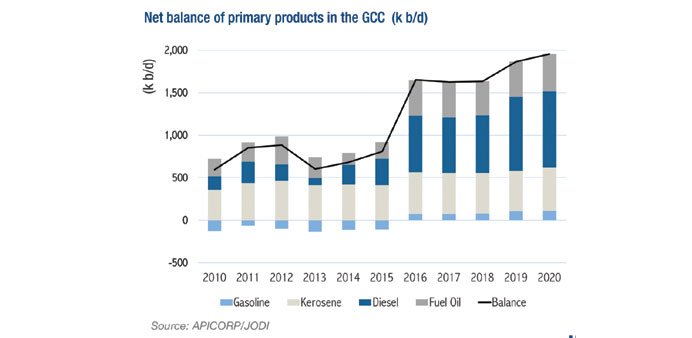
Diesel exports from the GCC are expected to rise sharply to 895,000 barrels per day in 2020 from the current 310,000 bpd, an Apicorp report has shown.
Gasoline export from the region, however, will be “modest” at around 100,000bpd by 2020, it said.
The new refineries in the Middle East (as elsewhere) have been configured mainly to produce diesel to cater to the anticipated increase of diesel demand from Asia, particularly from China.
However, China’s economic rebalancing — away from manufacturing towards consumer goods and services — has changed demand patterns within the country.
Diesel demand, related to heavy industry and transport of goods, is flat-lining while gasoline demand related to personal transportation continues to grow.
This, Apicorp said, has turned China into a net exporter of diesel, with net exports averaging 76,000 bpd in 2014 and hitting 166,000 bpd in July this year. With US exports of distillates surging to record levels, Russia upgrading its refineries to produce more distillates, and Indian refineries ramping up their production, the competition in the products market, particularly in the diesel segment, has become more intense.
“This is squeezing margins and may force some of the least efficient refineries to close, though shutting refining capacity could prove to be a lengthy process as factors other than profitability enters into the decision,” Apicorp said.
The new refineries in the Middle East will be the ones that survive in this competitive landscape — the key question being whether they will be able to achieve a positive return. This, however, will depend on a number of factors; some are specific to the companies (namely, their efficiency in implementing the projects and their operational efficiency); some are country-specific (reforming energy prices); while others are sector-specific (the size and complexity of global refining capacity and changing demand patterns).
“Faced with increased competition in global products markets, subsidised prices in local markets, and overcapacity in global refining, it is a good time for governments to re-evaluate their downstream strategies. Already, we have seen refining projects struggle to find adequate financing in a large number of countries, including Kuwait, Bahrain, Iran, Iraq, Jordan, and Algeria.
“In this current environment, where many governments will be forced to seek private sources of finance to fund many of the planned projects, they have to show that these projects are adding real value and are not solely driven by the increasing pressure to meet ever-increasing demand,” Apicorp said.