Bloomberg
Madrid
Bond investors, get ready for quantitative easing to mutate in Europe.
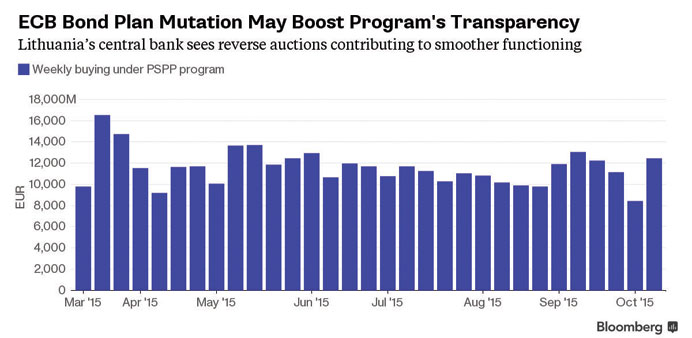
The European Central Bank this week started a limited pilot programme to test out buying bonds through auctions rather than approaching dealers one to one. Strategists say the system is designed to improve QE’s transparency and may eventually be rolled out across the euro region.
Two of the three central banks testing the new process on behalf of the 19 member states said they’ll release details of the securities to be acquired before they approach owners. Banque de France already published its first shopping list on Tuesday ahead of an auction later this week.
“Auctions encourage competition, offer more transparency and concentrate market-wide liquidity,” said Haoxiang Zhu, assistant professor of finance at the Massachusetts Institute of Technology, who has studied this method of buying debt at the Federal Reserve. They are “usually more efficient than purchases done bilaterally in a decentralised fashion.”
The QE programme has become the main driver of the eurozone’s bond market, with average sovereign yields tumbling to a record within days of it starting in March. The programme has been dogged by suggestions it erodes market liquidity and stokes volatility, while investors have said it makes it difficult to anticipate demand.
Central banks in the euro area have so far bought more than €340bn ($389bn) of debt under QE, which aims to boost inflation and growth by freeing up cash to circulate in the economy. Speculation is rife that officials will soon announce an extension of the plan beyond September 2016.
The pilot programme uses reverse auctions, where potential sellers compete to undercut one another on price. The Fed used a similar system for its QE programme. The ECB announced the trial on October 5, saying it would be carried out “without prejudging in any way whether the Eurosystem would consider applying auctions more systematically.”
The French central bank published a list of ISINs, or International Securities Identification Numbers, ahead of its October 16 auction, while the Dutch have pledged to do the same before their first purchases next week. The two banks said the Bloomberg auction system will be used to carry out the process.
“Higher transparency of the purchases is expected to encourage deepening of the securities market, as well as contribute to its smoother functioning,” Lithuania’s central bank, the third participant in the trials, said in a statement. It held the first reverse auction on Tuesday, said Mindaugas Vaiciulis, head of the market operations department.
The method will become “the norm” across the euro region, Antoine Bouvet, a London-based rates strategist at Mizuho International, said in a note last week.
Others aren’t so sure.
Unlike the Fed, the ECB is hampered by not having a single debt market, according to Commerzbank AG, the biggest primary dealer in German government bonds. There are also limits on what eurozone central banks can purchase, from not owning too much of a single issue to being prevented from buying securities yielding less than the ECB’s deposit rate.
“Reverse auctions can increase transparency, however they do reduce flexibility on behalf of the euro system, and this will probably make it challenging to implement this for the entire QE programme,” said Christoph Rieger, Commerzbank’s head of fixed-income research in Frankfurt. “There’s already a challenge to figure out where to buy, given the various restraints they have.”