


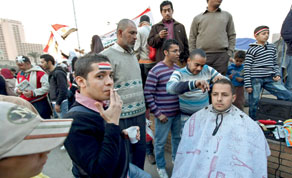
Reuters/
An anti-government protester has a haircut in
Egypt

Mubarak, 82, who refuses calls to end his 30-year-old rule before September polls, saying his resignation would cause chaos in the Arab world’s most populous nation, has tried to focus on restoring order and his government seems to be buying time.
Protesters, barricaded in a tent camp in
Keen to get traffic moving around
The powerful army’s role in the next weeks is considered critical to the future of
“The army is getting restless and so are the protesters. The army wants to squeeze us into a small circle in the middle of the square to get the traffic moving again,” protester Mohamed Shalaby, 27, said by telephone.
The uprising, which some activists have called the “Nile Revolution”, may have cost 300 lives so far, according to the UN.
The opposition has been calling for the constitution to be rewritten to allow free and fair presidential elections, a limit on presidential terms, the dissolution of parliament, the release of political detainees and lifting of emergency law.
“We are assessing the situation. We are going to reconsider the whole question of dialogue,” the Brotherhood’s Essam el-Erian said yesterday. “We will reconsider according to the results. Some of our demands have been met but there has been no response to our principal demands that Mubarak leave”.
The Muslim Brotherhood movement was among the groups that met Egyptian government officials at the weekend, a sign of how much has already changed in an uprising that has rocked the Arab world and alarmed Western powers.
The presence at the weekend talks of the banned movement, whose members have for years been repressed by Mubarak’s feared security forces, was a significant development that would have been unthinkable before the uprising.
The Brotherhood is seen as by far the best organised opposition group, whose potential rise to power troubles Egypt’s Western allies.
Opposition figures reported little progress in the talks. Protesters worry that when Mubarak does leave, he will be replaced not with the democracy they seek but with another authoritarian ruler.
The government issued a statement after a first round of talks on Sunday and said there was agreement on a road map for talks, which gave little ground on many opposition demands.
It suggested reforms would be implemented with Mubarak staying in power until September. It also put conditions on lifting emergency law, which the opposition says has been used to stifle dissent and should end immediately.
Mubarak’s new cabinet pledged yesterday to keep subsidies and draw in foreign investment in its first meeting since the uprising against poverty, high prices and an end to Mubarak’s rule.
With a government pledging to reform, an opposition with limited political experience, a constitutional process that mitigates against haste, and a key strategic role,
Appearing to soften her position for Mubarak to step down, US Secretary of State Hillary Clinton has said her policy on Egypt looks “over the horizon” to its possible democratic future - a future that must be carefully planned.