


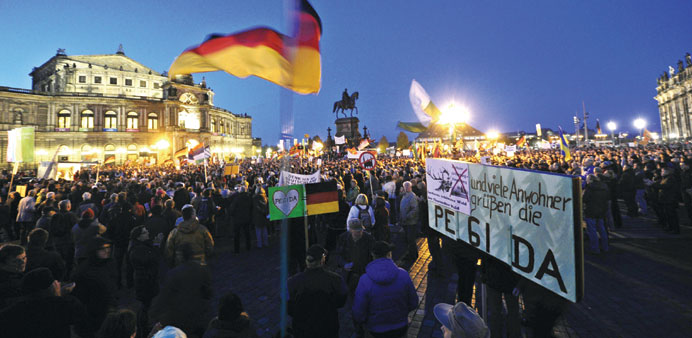
Supporters of the PEGIDA movement gather at a protest rally on the theater square in Dresden, eastern Germany. After months of dwindling attendance, its weekly marches have seen thousands gather amid mounting anger over Germany’s record refugee influx.
Agencies/Berlin
Border transit zones have emerged as the latest issue splitting Germany’s ruling coalition, as the country seeks to find a way to grapple with the press of people seeking entry amid Europe’s refugee crisis.
Social Democrats (SPD) expressed misgivings yesterday after a spokesman for chancellor Angela Merkel hinted the zones might be necessary to streamline the processing of people into groups of potential asylum seekers and those whose claims to enter Germany required additional review or merit rejection.
Talks within the coalition - where the SPD is a junior member to Merkel’s conservative Christian Democrats (CDU) - on creating such zones should start “as soon as possible”, the chancellor’s spokesman, Steffen Seibert, said yesterday.
Under the transit zone plan, asylum seekers travelling from a country deemed safe or who are not carrying identity papers or who are considered to have false identity papers would be detained at centres set up along the border.
“We urgently need more order concerning the entry of refugees, but I reject the establishment of detention centres for thousands of asylum seekers on the border,” said SPD parliamentary faction leader Thomas Oppermann in Berlin.
Officially, Berlin expects the numbers of refugees arriving in Germany this year to be about 800,000, with a large proportion of the asylum seekers coming from war-ravaged nations such Syria, Afghanistan, Iraq and Eritrea.
However, some German state governments believe that the number could be 1mn or more.
Oppermann described the transition zone proposal as “impracticable and wrong from a human point of view”.
He said it was certainly true there needed to be a more rapid registration of refugees as part of accelerated asylum processes. But he added: “Prisons do not help.”
Seibert acknowledged that transit zones were “not the means to solve all problems”, but said they could help “to bring order to the current refugee situation”.
The CDU’s Bavarian-based associate party, the Christian Social Union, has been spearheading efforts to set up transit zones. The proposal has also been backed by Merkel’s interior minister, Thomas de Maiziere.
The government has so far not laid out a concrete timetable for the transit zones.
But Germany’s new refugee coordinator, Peter Altmaier, said yesterday that a decision on transit zones is likely to be made by next week.
The transit zones would help the government “to better distinguish between the people who we want to protect and will protect ... and the people who come for economic reasons”, Altmaier told the German public broadcaster ZDF.
Last week Merkel appointed Altmaier, who heads up her office, as coordinator for refugee policy in the wake of the surge in the number of asylum seekers attempting to reach Germany.
The daily stream of refugees crossing into Germany has sparked political tensions in the nation about whether the country can handle the wave of migrants, leading to a slump in opinion poll ratings for Merkel.
Underlining the scale of the refugee crisis, CDU party general secretary Peter Tauber said the asylum issue could have a decisive influence on the outcome of the next elections set down for 2017.
“If we succeed in mastering this challenge, then the CDU will succeed at the next elections,” Tauber said.
Meanwhile, the chancellor has launched an offensive to sell her liberal refugee policy to sceptical members of her conservative political bloc as well as the wider German public. This includes a string of media interviews as well as addressing the European parliament and speaking at CDU party events.
The chancellor also plans to address the German parliament on Thursday ahead of an European Union leaders summit in Brussels on migration later in the week.
lIraqi asylum seekers rallied in central Helsinki and signed a petition yesterday against Finland’s plans to negotiate a deal with Baghdad that could lead to their deportation, arguing that their country should not be considered safe.
Hundreds of thousands of asylum seekers from conflict- and poverty-stricken parts of the Middle East, Asia and Africa have streamed into Europe this year, with even far-northern Finland becoming the final stop for more than 21,000, mostly from Iraq.
Encouraged by relatively broad Finnish asylum criteria and an existing Iraqi community in the Nordic country, they have taken a long circuitous journey up through central Europe and Sweden to reach Finland’s border near the Arctic Circle.
The government has responded by suspending decision-making on asylum claims by Iraqis and Somalis, saying it might tighten guidelines for granting people asylum after reassessing the security situation in both countries.
Helsinki has also begun to negotiate an accord with Iraq on deportations of asylum seekers judged not to have had a genuine fear for their safety or of persecution, but rather to have come more as economic migrants to better their living standards.
More than 300 Iraqi asylum seekers signed a petition to the Finnish government criticising its plans, and around 50 rallied in central Helsinki holding up with signs saying, “Baghdad is not safe, do not deport Iraqis!”
Saad, a 37-year-old asylum seeker from Baghdad who did not give his family name, said he had left Iraq in 2006 after his brother was killed in sectarian violence.
He said Sweden deported him back to Iraq in 2010 after Stockholm signed a deal similar to one Finland is now seeking.
Back in Baghdad, Saad said the Shi’ite Muslim authorities branded him a “terrorist” and that he was held in a camp and beaten, after which he was denied an apartment and became homeless because he came from a Sunni Muslim part of the capital.
“The Iraqi government promised that we would be safe, but we weren’t ... If I am deported back to Iraq, I will end up in prison,” he told a news conference.
Large parts of Iraq have been plagued by sectarian conflict since the 2003 fall of Sunni dictator Saddam Hussein. Iraq now has a Shi’ite Muslim-dominated government that is battling ultra-hardline Sunni Islamic State militants who control a third of the country. At least 57 people were killed last week in car bomb attacks in Baghdad and other cities.
A total of 50,000 asylum seekers are expected to reach Finland this year, up from just 3,600 in 2014.