Reuters/Jeddah/Dubai
Countries in North Africa and the Middle East are urgently seeking ways to soften the blow of surging food prices for their citizens, alarmed by protests against rulers from Algeria to Yemen.

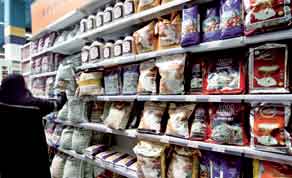
A customer shops for rice at a grocery store in Dubai on Tuesday
Food costs are among the grievances of demonstrators around the region as global food prices hit record highs in December, above levels that prompted riots in 2008, according to the UN’s Food and Agriculture Organisation, which warned prices of cereals, oilseeds, dairy, meat and sugar are set to climb.
Arab attention is keenly focused on Egypt, as wheat prices, already up on supply shortages caused by drought in Russia and floods in Australia, continue to climb to multi-year highs on futures markets closely watching unrest in the region.
“The government has to take care, monitor prices and improve salaries,” said Raeda al-Farooki, a mother of four, at a large supermarket in Saudi Arabia’s port city of Jeddah.
“Onions were about 5 riyals ($1.3) per kilo two years ago and now are around 10. Imported food is even more expensive, but the worst part is that there is no increase in salaries,” said Farooki, who lives on 6,000 riyals ($1,600) per month.
Algeria, Libya and Jordan have either relaxed food taxes or duties on food imports or cut prices of staple food, and Kuwait recently introduced a generous stipend and free food for its citizens until March 2012 to ease the pain of higher costs.
There is also simmering unrest in Yemen, the poorest Arab country, where 40% of the population lives on less than $2 per day.
At last week’s World Economic Forum in Davos, world leaders warned that soaring food prices could trigger more unrest and even war.
“Imagine the pressure on food, energy, water and resources,” Indonesian President Susilo Bambang Yudhoyono said in a speech at Davos. “The next economic war or conflict can be over the race for scarce resources, if we don’t manage it together.”
To provide work and diversify its economy from oil, Saudi Arabia is in the third year of a $400bn five-year programme, but spending has to be managed carefully to avoid adding to inflation.
Inflation has been on the rise across the Gulf in the past year, hitting multi-month highs, but consumer price growth remains far below record highs above 10% seen in most Gulf nations in 2008, during the peak of the construction and investment boom.
Gulf inflation is projected to be between 2.8 and 5.0% this year.
Saudi Arabia’s central bank governor has already expressed concern over inflation in the kingdom, which much like its neighbours imports around 70% of its food needs.
In Kuwait, which saw the steepest annual food price rise in the Gulf last year at 8.5%, its emir ordered the distribution of $4bn in cash and free essential food.
Morocco’s government, which heavily subsidises food and gas, has vowed to keep food prices at affordable levels “at any price” for its population of 32mn.
Growing more food locally is not a viable option for countries in the world’s top oil exporting region, with extreme summer temperatures that can top 50 degrees Celsius and limited access to water.
Investing for the longer term, they are leasing and buying farmland in developing nations to cut the swelling food import bill.
“Subsidies is one way over the short term but they all have to think how they can be effective in investing abroad in various agricultural producing countries,” said John Sfakianakis, chief economist at Banque Saudi Fransi.
Hassad Food, owned by Qatar’s sovereign wealth fund, has been in talks with governments in Argentina and Ukraine to buy farmland for cereals production.
In Saudi Arabia, where food accounts for a quarter of household costs - more than anywhere else in the region - the government is boosting wheat reserves to cover its needs for a year instead of six months.
“The inflation is burning a bigger hole in my pocket as my salary has not increased for the last two years,” said Kassim al-Falahi, an Omani government employee. “With three kids and parents to look after, it is tough to keep up with rising prices of food.”