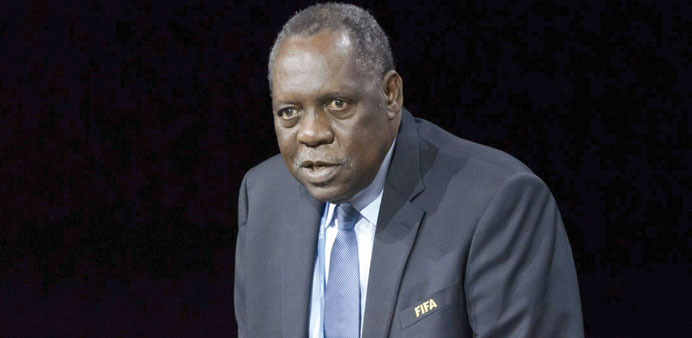
FIFA’s Senior Vice-President Issa Hayatou. (AFP)
By David Conn
The Guardian
Issa Hayatou, 69, the new acting president of FIFA following the 90-day suspension of Sepp Blatter, is a prime example of a long-serving FIFA chief whose career would have been curtailed had time limits for service, which are now being proposed, been in place.
The latest internal proposals for reform are that the FIFA president and members of the executive committee should serve a maximum of 12 years – three terms of four years. Hayatou has been a member of the 24-person executive committee for more than twice that period – 25 years, having first ascended to the top table in Zurich in 1990, when Blatter was the organisation’s general-secretary.
He has been the president of the Confederation of African Football for two years longer than that, having maintained his dominant position over the continent’s football administration for 27 years, since he was first elected in 1988.
In April the CAF statutes were changed to remove age limits; previously officials had to step down at the age of 70, but Hayatou, who reaches that age in August, will now be able to continue as the president and even stand in 2017 for another four years.
He finally becomes president on an interim basis, until the election of a new one in February according to the process by which Blatter voluntarily stepped down, 13 years after he challenged Blatter for the presidency in 2002 but lost. A former PE teacher and athlete, 400m and 800m champion in his native Cameroon, a member of the national basketball team who played football at university according to CAF, Hayatou has been a meteoric riser in football administration.
He first became general secretary of the Cameroon Football Federation (CFF) in 1974 at the age of 28, served as a government minister for sports, became the CFF president in 1985 then CAF president three years later.
In 1990, the year he joined FIFA’s executive committee, Cameroon’s national team made a huge impression on the World Cup in Italy, reaching the quarter-finals where they were narrowly defeated 3-2 by England.
During his time at FIFA, Cameroon and African football generally have made great improvements in playing standards and gained increased recognition and World Cup places, although many problems remain, including widespread financial difficulties, and there is a perception that many national associations, which have supported Blatter, have been over-reliant on funds from FIFA.
Hayatou was implicated in the scandal of FIFA executive committee members, including the former president Joao Havelange, being exposed for receiving bribes from the marketing company ISL before its 2001 collapse. The BBC’s Panorama programme in 2010 alleged that a list of ISL payments showed Hayatou received 100,000 French francs. He subsequently admitted receiving money but said it was not a corrupt payment but a gift for his confederation and that he used the cash for CAF to celebrate its anniversary.
Hayatou was not sanctioned by FIFA over the payment, nor mentioned in the ethics committee report of its investigations into ISL bribes, but he was reprimanded by the International Olympic Committee, to which he was elected in 2001. The IOC said that “personally accepting a sum of money in these conditions constitutes a conflict of interests”.
Hayatou has promised as the acting president to “dedicate my best efforts to the organisation, the member associations, our employees, our valued partners, and football fans everywhere”. He said: “FIFA remains committed to the reform process, which is critical to reclaiming public trust.”