


Bloomberg
Tokyo
Economists brought forward forecasts for when the Bank of Japan may next increase stimulus after economic data that pointed to the risk of the economy falling back into recession.
With concern growing that the weak outlook is making it more difficult for governor Haruhiko Kuroda to reach his 2% inflation target, 15 of 36 analysts now predict the central bank will boost its unprecedented asset-purchase programme at a meeting on October 30, according to a Bloomberg survey conducted from September 29 to October 2. This is up from 11 in a September survey.
“Further easing is the only choice left to the BoJ,” said Masaaki Kanno, an economist at JPMorgan Chase & Co and former BoJ official. “If the BoJ doesn’t act in October, its credibility will be hurt, triggering yen gains and slump in stocks.” Two economists project a move at the next meeting ending on October 7 while 13 don’t expect any policy change at all.
Barclays and Credit Agricole are among those who brought their projections forward after an unexpected decline in Japanese industrial production in August points to the possibility of a second-straight quarter of economic contraction.
Options for further stimulus include speeding up the pace of Japanese government bond purchases to ¥100tn ($830bn) a year from ¥80tn, extending the average maturities of JGBs bought, buying more exchange-traded funds and cutting the interest rate on excess reserves, according to Barclays economists Kyohei Morita and Yuichiro Nagai.
BoJ officials see little need for an immediate expansion of monetary stimulus and would prefer to hold off to get a clearer picture of the economic outlook, people familiar with their discussions told Bloomberg earlier this month.
While there’s a risk that gross domestic product shrinks in the third-quarter “the question is whether this represents a slide into a full-blown recession or if it is a soft patch,” said Izumi Devalier, an economist at HSBC Holdings. She is one of the 13 who don’t expect more easing. “The BoJ clearly thinks it’s the latter, and we’d agree.” Kuroda began unprecedented stimulus in April 2013 with his aim to achieve the 2% price target in about 2 years. He said last week the bank expects to hit the target around the six months through September 2016, while that timing could change depending on oil prices.
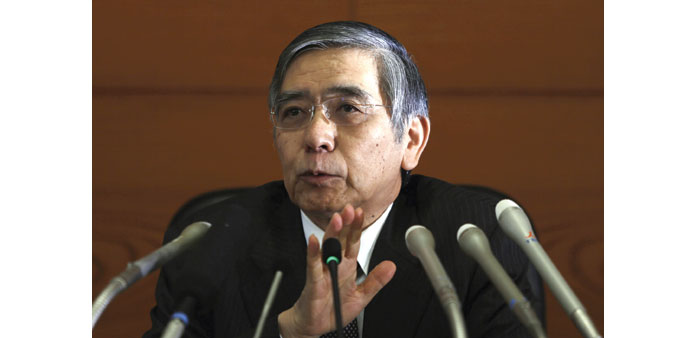
Kuroda: Exploring all options to reach 2% inflation target.