


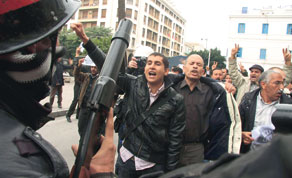
Reuters/Tunis
A riot policeman faces off with protesters during a demonstration in downtown
Tunisia

Prime Minister Mohamed Ghannouchi brought opposition leaders into the coalition on Monday after president Zine al-Abidine Ben Ali fled to
But key figures from the old guard kept their jobs, angering opposition members of the coalition and street protesters.
In a bid to defuse the row, Ghannouchi and the caretaker president, Fouad Mebazza, later quit their party, the Democratic Constitutional Rally, long the vehicle for Ben Ali’s authoritarian rule. State television, which reported the move, said the two men hoped to “split the state from the party”.
But the immediate response of trade union UGTT was that, while this was positive, it was not enough to reverse a decision to pull its three members out of the new unity government.
Police in
Several hundred people also protested against the new government in Monastir, south of
The weeks of protests over poverty and unemployment which forced Ben Ali out prompted speculation across the Arab world that other repressive governments might also face unrest.
Signalling concerns in financial markets, Standard and Poor’s said it might cut
Abid al-Briki of the UGTT union said it still wanted to see all ministers from Ben Ali’s cabinet pushed out, though it would make an exception for Ghannouchi: “This is in response to the demands of people on the streets,” Briki said.
The opposition Ettajdid party will pull out of the coalition if ministers from Ben Ali’s RCD party do not give up party membership and return to the state all properties they obtained through the RCD, state television said.
Ettajdid leader Ahmed Ibrahim was named minister of higher education.
Opposition Health Minister Mustafa Ben Jaafar also resigned over the presence of RCD members in the cabinet, his party said.
On the streets, protesters insisted that ministers who had served Ben Ali had no place in the government.
“The new government is a sham. It’s an insult to the revolution that claimed lives and blood,” said student Ahmed al-Haji.
“The problem with the interim government is it has a number of ministers from the old government,” protester Sami bin Hassan said.
Ghannouchi defended his government, saying some ministers had been kept on because they were needed in the run-up to elections, expected in the next two months.
The prime minister said the ministers of defence, interior, finance and foreign affairs under Ben Ali would keep their jobs in the new government.
“We have tried to put together a mix that takes into account the different forces in the country to create the conditions to be able to start reforms,” Ghannouchi told
Ghannouchi rejected suggestions that the Ben Ali “dictatorship” would continue under a new guise.
His foreign minister, Kamel Morjane, said during a visit to
“It may be possible that the next government will not have any member of the former government,” he said.
Paris-based opposition leader Moncef Marzouki arrived at
“The revolution must continue,” Marzouki, who went into exile after being harassed by Ben Ali’s intelligence services, said.
In