


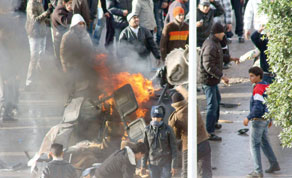
Reuters/Tunis
Protesters burn furniture during a clash with riot police in Cite Ettadhamen near
Five people were killed in renewed clashes in

Facing his most serious challenge since he came to power more than 23 years ago, President Zine al-Abidine Ben Ali offered an olive branch by firing his interior minister and freeing jailed protesters. But the moves failed to halt the violence.
People taking part in the unrest say they are angry about unemployment, corruption and what they say is government repression. Officials say the protests have been hijacked by a minority of violent extremists who want to undermine
Crowds of people gathered to protest in three provincial towns, witnesses said. In Gassrine, about 200km from the capital, several thousand people chanted “Ben Ali, go away!”
In the Sahara desert town of
Two witnesses said that police in the town of
The victim was deaf, said his brother, Ramzi.
“The police told him to go home but he heard nothing, and they fired towards him,” he said by telephone. “They (the government) promised us and promised us and now they have promised us death,” he said.
Officials did not respond to calls seeking comment on the witness accounts about the killings. The government says police only fire in self-defence when violent rioters attack with petrol bombs and sticks.
Some analysts say the Tunisian government is likely to be able to contain the unrest but that in the longer term Ben Ali could find himself weakened and his opponents emboldened.
Adding to mounting international pressure on
“We cannot accept the disproportionate use of force by the police against peaceful demonstrators,” Maja Kocijancic, spokeswoman for EU foreign affairs chief Catherine Ashton, said.
The protests, now entering their fourth week, are being watched closely in other countries in the Arab world with the potential for social unrest.
The government declared a nightly curfew for
When the curfew began in the El Omran neighbourhood on the outskirts of the city, hundreds of youths who had been throwing stones at police carried on, a reporter at the scene said.
He said police responded with teargas and by firing into the air. The youths had earlier set fire to a bank branch.
The latest official death toll from the unrest—which is now entering its fourth week—is 23, though some international rights groups say the count is higher.
Earlier, in an attempt to take the momentum out of the unrest, Prime Minister Mohamed Ghannounchi said the president had decided to appoint Ahmed Friaa, an academic and former junior minister, as the new interior minister.
He did not give a reason for the change but he said the president “has announced the creation of a committee of investigation into corruption and to assess the mistakes of certain officials.”
In further concessions, he said Ben Ali had decided to free everybody detained for taking part in the riots and promised financial help to jobless graduates—a group whose grievances have been a driving force behind the unrest.
Military Humvee jeeps and armed soldiers were patrolling at least two locations in the centre of
The unrest has alarmed investors in