


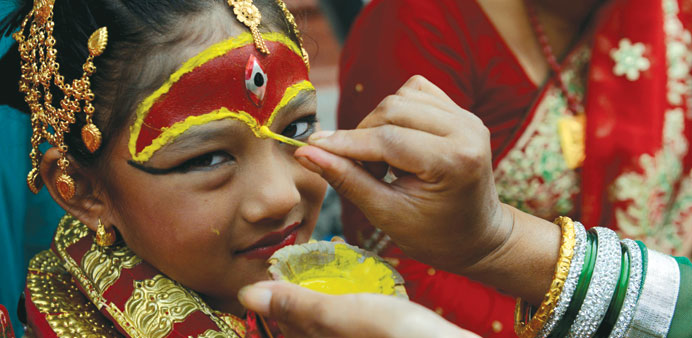
A Nepalese girl dressed as a Kumari has make-up applied before taking part in Kumari rituals at the Hanuman Dhoka in Durbar Square in Kathmandu. Some 500 girls under the age of nine from across the country were brought to the temple for the rituals.
DPA
Kathmandu
A toned-down version of the annual chariot ride of Nepal’s Kumari began yesterday in the capital, Kathmandu, as the country tries to carry on with the tradition amid the lingering effects of a deadly April
earthquake.
The festival - during which the Kumari - is taken around old Kathmandu on a human-drawn chariot in the evenings for a week during the month of September - is considered the city’s biggest festival.
Due to the April 25 earthquake, which killed nearly 9,000, most of Kathmandu’s old buildings have been destroyed. The Basantapur Durbar Square area, the old seat of the government, still sports many half-crumbling
buildings propped up on struts.
“We had to hold the chariot ride in the afternoon instead of in the evening, like it is done customarily (because of the danger from the buildings),” said Jagat Narayan Maharjan, a member of the festival’s management committee, as he watched the chariot make its way through the narrow city streets.
“Dragging the chariots through the town this year is a big challenge as the buildings are supported by struts in narrow streets and the chariot-pullers have to manouevre that.”
Basantapur Dubar Square saw a spike in visitors as the festival began.
Due to the destruction of historical monuments, a pavilion had been set up temporarily for the occasion, where the president, prime minister, ministers and foreign
dignitaries were seated.
“The festival doesn’t feel the way it used to any more,” said Laxmi Tamrakar, a caretaker at a temple. “Everything is in such a mess, but we can’t even call off or postpone the festival.”
The Kumari is always a pre-pubescent girl filling a role that has been considered for centuries as the benefactor of the monarchs. Although Nepal abolished monarchy in 2008, the institution of the Kumari continues, as it is strongly tied with the faith of the native residents of Kathmandu, the Newars.