


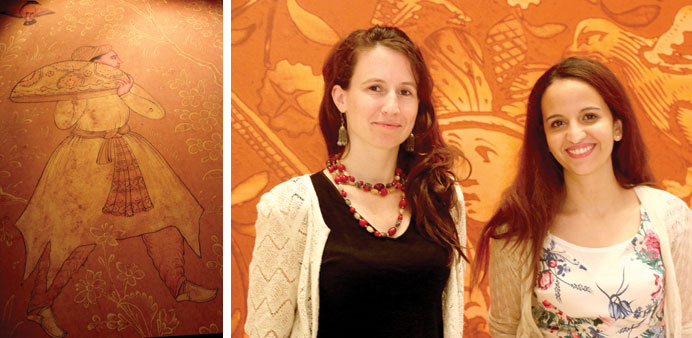
FEAST: Feasting on the hunted animals was an important part of the hunt.Right: Julia Tugwell, Assistant Curator, left, with Dr Mounia Chekab Abudaya, the Curator MIA, curated the exhibition.
Umer Nangiana gives a firsthand view of special pieces from the Qatar Museums collections and objects brought from Topkapi Palace Museum and the Turkish and Islamic Art Museum, Istanbul
Primarily, a source of food and skin clothing, hunting later became not just a symbol of royalty and bravery, it afforded a rich source of art in the Islamic world.
Hunting used to be a part of daily life, but it was dangerous and took the bravest of men to nail it.
A horseback javelin chase, designed to kill large animals, could just as easily kill a hunter in pursuit. Starting with Abbasid era in the context of princely life, hunting at one point became an essential part of a prince’s education.
Trained in horsemanship, archery, the art of holding feasts and audiences, falconry and all that concerned hunting involving the law, oratory and generalship, the king or the prince would lead the hunt. The bravest of them would face wild beasts with zeal.
So integral to those societies, hunting has been depicted in magical forms on utensils, ceramics and sometimes in the form of ornaments shaped as prey animals. Entire stories of hunt are captured on pieces of art descending from the era of princely pursuits.
The Hunt; Princely Pursuits in Islamic Lands, a new exhibition launched at the Museum of Islamic Art (MIA) under the patronage of Qatar Museums Chairperson, HE Sheikha Al Mayassa bint Hamad bin Khalifa al-Thani, combines many such stories, told over centuries from 11th right up to the 20th.
“We are trying to let the visitor explore the history of hunting besides the lifestyles of royal hunters. They would gain knowledge about the hunters’ skills and the bravery they possessed in order to hunt,” Shaikha al-Nassr, Head of Exhibitions at MIA, told Community in a chat at the preview of the exhibition which opened for the public on September 16 and is to last until January 9 next year.
“There are a lot of special pieces on display. They come from Qatar Museums collections and we are privileged to have brought some of the objects from Topkapi Palace Museum and the Turkish and Islamic Art Museum from Istanbul,” she added. Each object in each section of the exhibition has its own importance, but she says her personal favourite was the diamond and rubies-studded hunter rings.
On display in the museum’s Special Exhibitions Gallery, MIA’s autumn exhibition focuses on hunting as a royal activity in Islamic lands, a major part of elite life in the Islamic world from earliest times until the present day.
It explores and celebrates the sport of hunting, as well as the related activities of polo, feasting and fighting, all of which feature prominently in Islamic art.
The manuscripts, ceramics, metalwork, textiles, glass, woodwork and hunting tools will give audiences the chance to marvel at the lifestyle, power and bravery of royal hunters, opening a window into the lives of princes, sultans and caliphs and exploring how the notion of kingship was expressed throughout the Islamic world.
“It shows a certain type of imagery that has been repeated in Islamic art. It offers all different kinds of mediums through different time periods. We are going through Spain to India,” Julia Tugwell, Assistant Curator at MIA, tells Community to explain the theme of the exhibition that she has curated alongside her colleague Dr. Mounia Chekab Abudaya, Dr Leslee Michelsen and William Greenwood.
“We see this imagery of huntsmen and its association with royalty so it has become a sort of symbol and it is interesting to see that this symbol has spread all over the place. It is not just confined to one country; it keeps reappearing in textiles or on ceramics,” adds Tugwell.
She says it is called the princely cycle in Islamic art. The curators say they have tried to keep a balance of different types of mediums from different periods just to show how it spread geographically and time wise.
The exhibition has been divided into sections, making it easy for audience to grasp. It starts with talking about the people and animals involved in the hunt. The hunter and this imagery of hunter as a symbol of royalty and power are then introduced.
“We talk about animals that were involved and we use different kinds of animals but one theme in particular is on falconry which is a symbol of royalty and that comes up quite often. Then, we move on to the animals that were hunted,” explains Tugwell.
Next is a section on tools that may have been used for hunting but likely not, as they are more pageantry items as well.
The last section is wider than just hunting. “Not only was hunting something that was considered as a gentlemanly thing to do but so was warfare and so was fighting games or polo,” says the curator.
And with it comes the idea of feasting that would be common to hunting where a king or prince would have all of his troops around and would in a sense reward them with what they had just hunted. It would be a way to create bonds between men and to show the strength and generosity of the king.
The ambiance will take you back in time to those hunting pursuits. Large images of hunters on horseback, feasts, animals and birds blown up on wall sized canvases surround the showcases of art pieces.
“The idea is to show blow-ups of the objects because you know sometimes on metals, ceramics and manuscripts, these are tiny little details that the viewer might miss. So it is actually quite interesting to use that in the design of the exhibition just to lead the visitor through the different sections and themes within the exhibition,” says Curator Dr Mounia.
The majority of the collection comes from MIA along with pieces from Qatar Museums with some coming from Topkapi Palace Museum and the Turkish and Islamic Art Museum from Istanbul.
Dr Mounia recommends hunting horn as a must-see piece. “It is actually made in Sicily or South Italy and it is in ivory, very finely carved into it. It is quite interesting because you have got the function of the hunting horn which was used during the parades or during hunting. Then you have got the imagery of the hunting scenes carved on the object itself,” she says.
The Hunt forms part of the Qatar Turkey 2015 Year of Culture, which aims to create sustainable platforms for collaboration and cultural exchanges between Qatar and Turkey.
“This fun and absorbing exhibition aims to use hunting as a means of exploring the ‘princely cycle’ and how notions of kingship were formulated, expressed and depicted in the Middle East and beyond,” says Shaikha al-Nassr, MIA Head of Exhibitions.
She hopes that the wide variety of objects and artworks on display illustrate this important part of history and society, and appeals to diverse audiences across the community, including children, young people, and families both in Qatar and across the region.
“The exhibition has strong relevance to regional culture, as seen with falconry, a form of hunting that is still an important part of Qatar’s heritage,” she points out.
Frequently commissioned and exhibited for royal display, such artworks form a significant component of collections held by prominent Qatari and international museums.