


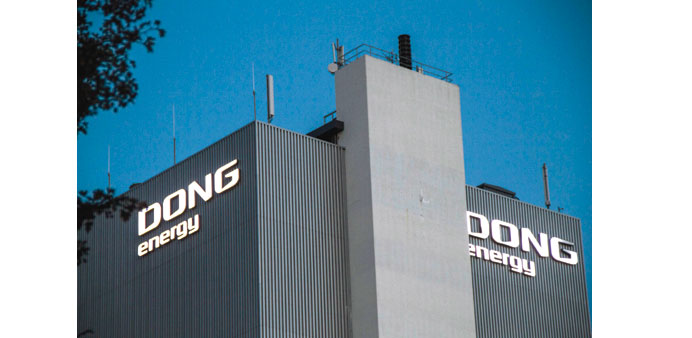
A gas-fired power plant operated by Dong Energy is seen in Denmark. The country is preparing what may become the biggest initial public offering in its history as it sets a road map for the sale of state utility Dong Energy.
Bloomberg
Copenhagen
Denmark is preparing what may become the biggest initial public offering in the nation’s history as it sets a road map for the sale of state utility Dong Energy.
The government is giving itself a maximum of 18 months, but Finance Minister Claus Hjort Frederiksen made clear he wants the process to be swift. “The sooner we get started, the better,” he said in a phone interview from Copenhagen.
The whole company, which comprises units in oil, gas, wind parks and distribution networks, could be worth as much as 70bn kroner ($11bn), according to Jacob Pedersen, an analyst at Sydbank. It will be a “huge” IPO and likely to attract “enormous attention,” he said. Frederiksen, who said the state will hold more than 50% after the IPO, declined to give a valuation when asked.
Denmark had initially earmarked Dong for a public sale by 2018. The company was at the centre of a dispute that resulted in a junior coalition member quitting the previous administration in protest after part of Dong was sold to Goldman Sachs last year.
The Wall Street bank paid about $1.5bn for an 18% stake. A number of lawmakers questioned the price, which they argued was too low. The government at the time said the cash injection Goldman delivered came at a crucial moment and under terms others weren’t ready to accept.
Dong said the IPO process will include a review of its Exploration and Production unit, which “operates in a structurally different market environment currently characterised by the significant drop in oil prices over the past 12 months.” Credit analysts have argued in favour of a sale of the unit, which Bloomberg Intelligence estimates may be worth as much as $8bn.
“I think it’s quite likely the strategic review of the E&P business will end with a sale,” Pedersen said. “It would make a lot of sense.” Doing so would reduce the company’s complexity and free up a lot of cash, both of which would help smooth the path toward a successful IPO, he said. The remaining units would focus on renewable energy sources.
“We strongly believe in the company’s long-term growth prospects as a sustainable energy company with world class capabilities within offshore wind and biomass,” Goldman Managing Director Martin Hintze said in an e-mailed response to questions.
The government said a potential divestment of the E&P unit won’t necessarily need to have happened before the IPO.
Dong said on Friday it intends to divest its gas distribution unit, as well as its oil and gas pipelines “at an appropriate time.” Taking all the moving parts and the IPO timeline into account adds to the difficulty of estimating a value for the whole company, Pedersen said.
While 70bn kroner is at the top end of Sydbank’s estimated range for Dong’s value, the company could also be worth as little as 50bn kroner, Pedersen said.
That would still make it Denmark’s biggest ever IPO, topping the state’s 1994 sale of TDC. Back then, Denmark floated about half the phone company’s shares in a deal that valued TDC at about 40bn kroner.
Shipping and oil conglomerate Maersk, which is also Denmark’s biggest company, is a strong candidate to buy Dong’s E&P unit, according to Pedersen. “It’s a perfect fit for Maersk,” he said. “We know that Maersk is looking for things to buy, and the strategic match couldn’t be better.”
After 2020, the Danish government can choose to cut its stake in Dong below 50% provided it gets parliamentary backing, the finance ministry said.
“It’s our ambition that the government should remain the majority owner, but we can’t make guarantees for all eternity,” Frederiksen said.