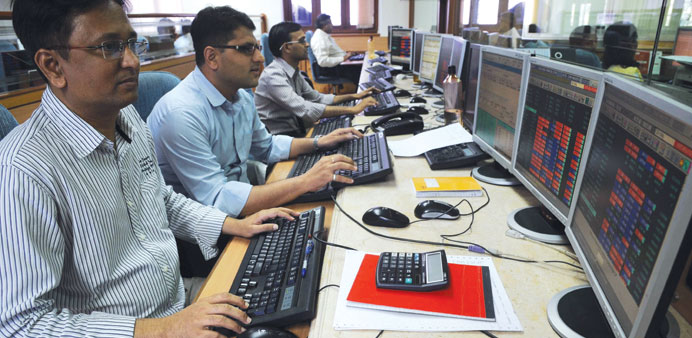
Traders at the Bombay Stock Exchange. India is considering allowing state retirement funds to invest more in equities and opening them up to private-sector management to improve returns, as Prime Minister Narendra Modi seeks to expand the country’s tiny pensions net.
Reuters/New Delhi
India is considering allowing state retirement funds to invest more in equities and opening them up to private-sector management to improve returns, as Prime Minister Narendra Modi seeks to expand the country’s tiny pensions net.
Hemant Contractor, head of the Pension Fund Regulatory and Development Authority (PFRDA), told Reuters he was pushing for state pension funds to be allowed to invest up to half of their funds in stocks, up from the current 15%.
“We have taken it up very strongly with the government,” Contractor said in an interview. “The moment the government accepts it, we will increase to 50%.”
The pension plans handle mostly state employees’ funds.
Finance Minister Arun Jaitley, who wants pension and insurance funds to invest more in equities and infrastructure, could make a decision soon, a ministry official said.
The pension savings of about $15bn overseen by Contractor’s agency are about just 1% of the Mumbai Stock Exchange’s $1.5tn market value. But asset managers expect them to grow four-fold over five years, mainly driven by higher deposits following tax exemptions this year.
Jaitley introduced a tax break this year on annual pension contributions of up to 50,000 rupees ($750), a step that could boost enrollments by 40-45% in this fiscal year, Contractor said.
Modi has also urged the $100bn state-run Employees’ Provident Fund Organisation (EPFO) to start buying stocks to lift its returns.
“There is a broad agreement that state employees should have an option on a par with private workers to invest in equity markets,” said a finance ministry official, who is involved in the policy process and spoke on condition of anonymity.
But most of India’s workforce is employed in the cash economy and has no formal retirement cover at all. Only about 12% of those in work actually have a pension plan.
Funds overseen by the PFRDA have returned more than 10% a year since it was set up in 2004. That beats the 8.5% earned by the EPFO, which invests mainly in government bonds, but barely beat inflation over the same period.
Private players see an opportunity in the pension savings of the 60mn state employees who contribute $13bn of the $15bn in assets overseen by the PFRDA.
The PFRDA plans to invite bids to manage more pension funds in the next two to three months. Awards would be based on the most competitive fees bid by asset managers.
“We are very positive,” said S. Bandyopadhyay, CEO of LIC Pension Fund, which manages $4.4bn. He forecast that PFRDA-regulated assets could grow by three or four times to $60bn over the next four years. Still fund managers say there is long way to go as low awareness of pension products, adverse tax rules and a lack of confidence in the stock market deter many potential investors.