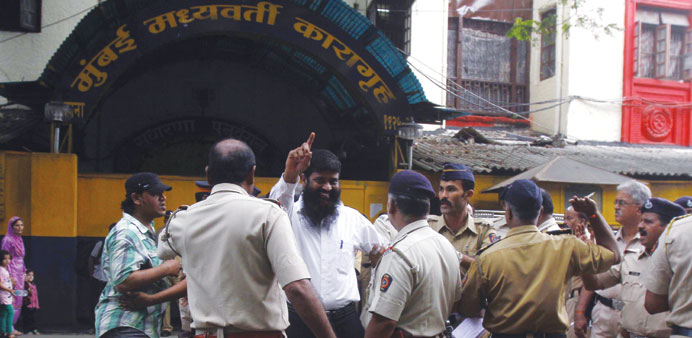
An accused in the 7/11 Mumbai train blasts case is taken away after being produced at the special MCOCA court in Mumbai yesterday.
IANS/Mumbai
Twelve people were yesterday convicted by a special court here in the 7/11 serial bombings that ripped through Mumbai trains and left 189 people dead.
The much anticipated verdict was delivered by special judge Y D Shinde of the Maharashtra Control of Organised Crime Act (MCOCA) court.
The court acquitted one person in the terror attacks which took place in 2006.
Besides murder, the accused were found guilty of various charges under the Indian Penal Code, MCOCA, Indian Railways Act, Explosives Act, Unlawful Activities Prevention Act.
While five accused have been found guilty of murder, all the 12 have been found guilty under MCOCA’s Section 3-1(1) - both attracting the death penalty, said special public prosecutor Raja Thakre.
Judge Shinde reserved the verdict on the quantum of punishment for September 14.
The convicts are Kamal A Ansari (37), medico Tanvir A Ansari (37), Mohamed Sajid Ansari (34), Sheikh Mohamed Ali Alam Sheikh (40), Mohamed Majid Shafi (30), Mohamed Faisal Sheikh (36), Ehteshan Siddiqui (30), Asif Khan alias Junaid (38), Muzammil Sheikh (27), Soheil Mohamed Sheikh (43), Zamir Ahmed Sheikh (36) and Naved Hussain Khan (30).
Abdul Wahid Sheikh is the lone accused who was acquitted in the case, while another prime accused Azam Chima, alleged to be linked to the Lashkar-e-Tayiba, is among the 17 absconders.
The trial dragged on for eight years in which the prosecution examined 192 witnesses, including policemen, civil servants, medicos, officials of various government departments, commuters, survivors and one person summoned as a court witness. Their deposition covered over 5,500 pages.
Besides claiming 189 lives, the serial train blasts left 817 people injured on the evening of July 11, 2006. Seven RDX laden bombs went off in trains at Matunga Road, Mahim, Bandra, Khar Road, Jogeshwari, Borivali and Mira Road stations spanning Mumbai and Thane districts.
The Anti-Terrorist Squad had claimed that the suspects belonged to Pakistan’s ISI, Lashkar-e-Tayiba and the banned SIMI.
The trial in the case started in June 2007, but was stayed in February 2008 after one of the 13 accused, Kamal Ansari challenged the phrase ‘promoting insurgency’ in defining organised crime in the Maharashtra Control of Organised Crime Act as “unconstitutional”.
In April 2010, the Supreme Court dismissed his petition and paved the way for the trial to resume.
Later, in December 2012, the Bombay High Court directed police to grant access to telephone call date records which showed that four persons accused of allegedly planting the bombs were not in the vicinity of Churchgate station or the blasts sites that evening.
The ATS alleged that some of them were in contact with the LeT in Pakistan and had carried out the blasts.
Police said highly sophisticated explosives ripped through mainly the first class compartments of the seven local trains all headed in the northern direction.
While two blasts occurred when the crowded trains neared Borivali and Mahim stations, the others took place when the trains were leaving the stations or nearing their destinations.
The explosions, using around 15-20kg of RDX, were so powerful that they blew off the double-layered steel roofs and walls of the seven train compartments.
Commuters and political parties across the spectrum as well as retired police officers welcomed the verdict and all eyes are now on the quantum of punishment which is likely to be announced on Monday.
“I think this is justice for all the people who died and those who were injured,” said former ATS chief K P Raghuvanshi, who was involved in the investigation.
Former Mumbai police commissioner A N Roy, who headed the city police at that time, expressed happiness over the outcome and the special court endorsing the charge sheet submitted after thorough probes by police and the ATS.