


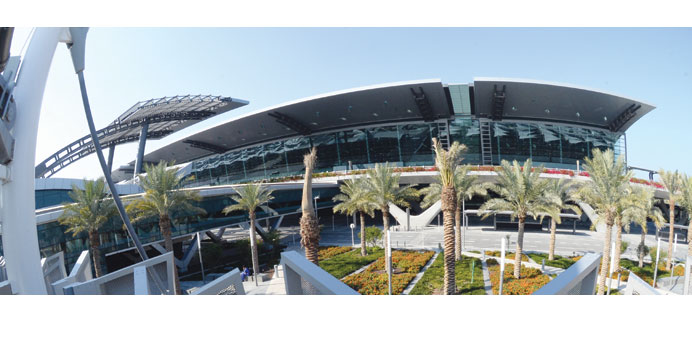
In 2014, Qatar opened its new international report, Hamad International Airport, with phase 1 capacity of 30mn passengers a year. The new report commissioned by air traffic management specialists NATS contains a dedicated section on Qatar, based on the rapid expansion of the country’s aviation industry.
An estimated $1.5bn in economic benefits can be achieved in Qatar over the next 10 years by delivering enhancements to air traffic control systems, according a new report commissioned by NATS, the air traffic management specialists.
The independent report — “Economic Benefits of Improvements to air traffic control” — was undertaken by Oxford Economics, which has been engaged in global forecasting and quantitative analysis for business and government.
The report contains a dedicated section on Qatar, based on the rapid expansion of the country’s aviation industry.
The national carrier, Qatar Airways, was established in 1994, since when it has grown exponentially, from four aircraft in 1997 to 152 today, serving 146 destinations and carrying over 22mn passengers.
Furthermore, Qatar Airways has over 330 new aircraft pending delivery over the next few years.
In 2014, Qatar opened its new international report, Hamad International Airport, with phase 1 capacity of 30mn passengers a year.
The 2022 FIFA World Cup in Qatar will bring even more passenger growth to Qatar, with Qatar’s market share of GCC aviation capacity predicted to increase by 17.1% by 2023, more than three times the predicted capacity growth of the GCC region’s share of global aviation.
However, Oxford Economics also calculated that the average flight in Qatar was delayed by 37 minutes and that 82% of those delays were attributable to air traffic control capacity and staffing issues. By 2025, without further investment in air traffic control systems, a doubling of delay minutes to 60 minutes would cost the country $1.5bn.
Despite the huge growth in aviation, as governments invest in increasing trade and tourist flows, the region’s available airspace has not kept pace, according to the report. In addition to approximately half the airspace in the Middle East being reserved for military flights, the number of handovers that take place between different authorities in different divisions of airspace can lead to additional delays. Although the report notes that the challenges faced are clearly recognised throughout the region, it goes on to say that ‘the pace of progress often does not meet the pace of continued traffic growth’.
John Swift, director, NATS Middle East, said: “This report highlights a clear economic case for much greater institutional, operational and technological investment in air traffic control systems across the region. It reveals that there are huge economic benefits available for airports, airlines and travellers, but also significant risks for governments in an increasingly competitive marketplace.
“As Qatar diversifies its economy and gears up for the hosting of major global sporting events, ensuring that aviation is up to world class standards is vital. The country has made huge strides in investing in aircraft and infrastructure — it is critical, though, that the ‘invisible infrastructure’ of airspace is not forgotten. Increased collaboration between civil aviation authorities and the private sector will go a long way to closing that gap.”
Kareen el-Beyrouty, senior economist, Oxford Economics, said, “We have a strong and proud track record for independent and objective analysis and we are pleased to have had the opportunity to study air traffic management in the Gulf region. We are not aware that such a study has previously ever been conducted in the region, certainly not in as much detail, and the sheer scale of the findings has surprised us. We very much hope it will be welcomed by the aviation industry and aviation authorities and that it helps to guide forward thinking on this topic.”
This is the first such report to have been undertaken into the impact of investment in regional air traffic control management.