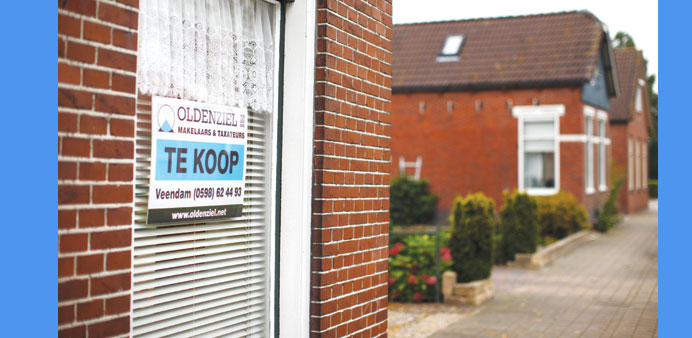
A ‘For Sale’ sign is displayed on the window of a residential property in Nieuwe Pekela, Netherlands. Seven years after a global financial crisis was sparked by lax lending rules, the Netherlands is the last country in western Europe where homebuyers can borrow as much as 103% of the purchase price — enough to cover a slice of the transaction costs as well.
Bloomberg/Amsterdam
Prinsengracht 199 in Amsterdam boasts a gourmet kitchen, a bath with canal views and vaulted ceilings. The price tag is €1.6mn ($1.8mn), but it could be yours for no money down.
Seven years after a global financial crisis was sparked by lax lending rules, the Netherlands is the last country in western Europe where homebuyers can borrow as much as 103% of the purchase price — enough to cover a slice of the transaction costs as well.
That will change if Dutch Central Bank President Klaas Knot has his way. Knot, 48, has advised the government to restrict mortgages to no more than 90% of the price. He wants to lower the country’s mortgage-debt-to-GDP ratio, aligning the Netherlands more closely with its neighbours and addressing criticism from the International Monetary Fund and the European Central Bank.
“High loan-to-value ratios make banks’ and household balance sheets vulnerable and go hand-in-hand with sharper fluctuations in house prices and the real economy,” Knot’s financial-stability committee wrote.
Surprisingly to people outside the Netherlands, almost everyone else with an interest in the Dutch housing market — from lenders to lawmakers to potential purchasers — opposes the plan, claiming it would scupper a recovery that has just begun to spread beyond cities such as Amsterdam.
“The only direction house prices can go is down” if Knot is successful, said Frans Schilder, a senior researcher at the Amsterdam School of Real Estate. “I don’t see a need to use such a kill-or-cure remedy to mortgage debt without offering an alternative, particularly to first-time buyers.”
Dutch home prices rose by an average of 0.9% in July from the previous month, the biggest increase in two years, the national statistics office said in a statement on Friday.
Knot made the proposal as part of his role as chairman of the Financial Stability Committee, a group created to advise the government on potential financial risks in a bid to avoid another financial crisis. At the end of 2014 about a quarter of Dutch homeowners had houses that were worth less than the amount they owe, which could hold back their readiness to spend.
Even Knot doesn’t think the country is ready for such a change overnight — his May proposal asked the next cabinet to consider the plan. Barring political disaster, there won’t be a new cabinet until 2017. Given the initial public reaction, it will be an uphill battle to get them to implement the suggestion.
From 2018, homebuyers would need to pay at least 1% of the purchase price. That would rise by one percentage point a year until 2028, when all Dutch buyers would need to pay at least 10% of the purchase price out of their own pockets.
Lowering the loan-to-value ratio to 90% would be “foolish,” the Dutch Association of Banks, or NVB, said in a statement, adding that such a change would damage the housing market. First-time buyers would have to delay the purchase of a home by at least five years, causing prices to fall by at least 5% initially, the NVB estimates. That would keep highly indebted homeowners under water for even longer, in contradiction to Knot’s aim, according to the NVB. Dutch planning agency CPB estimated the change would lead to an initial drop of 3%.
“Reduction of debt is always positive, but timing is very important,” said Jeroen van Hessen, a managing partner at the Dutch Mortgage Funding Company. “It’s not wise to restart a discussion about lending rules just as the housing market is starting to recover.” Van Hessen’s company invests more than €2bn in mortgages on behalf of pension funds.
ING Groep and ABN Amro Group, two of the biggest Dutch lenders, referred to the banking association statement when asked to comment on the proposed change.
One politician who hasn’t publicly backed a change is Finance Minister Jeroen Dijsselbloem, who garnered global attention earlier this year for insisting on increased austerity from Greece in his role as the head of the group of euro-area finance ministers.
In May, Dijsselbloem said the Dutch mortgage market has undergone reform by his government and limited the current cabinet’s plan to lower the maximum loan-to-value to 100% in 2018. Any other changes would be left to future cabinets.
It’s true that the Dutch mortgage industry has come a long way in the past five years. Until the end of 2012, lenders had self-imposed loan-to-value limits and as of 2007, the average was 115%, according to the Dutch markets regulator AFM.
What’s more, it was possible to own a house for 30 years and never pay off a cent from the principal. Following a slew of reforms, buyers must pay down all the principle in order to qualify for full tax relief. Homeowners are allowed to deduct all their interest payment from taxes for 30 years.
With those changes and circumstances such as lower interest rates, “the market is taking care of it on its own,” Rabobank Groep Chairman Wiebe Draijer said at a press conference on Thursday. “So an additional measure to achieve that 90% doesn’t seem opportune at this time.”
“The Dutch combination of large loan-to-value-ratios and large state subsidies is unique,” said Jochen Moebert, an economist at Deutsche Bank in Frankfurt.
The rules may seem odd for a country like the Netherlands, which isn’t known for its extravagance. Yet because the Dutch have a high pension-contribution rate, most people haven’t relied on their home to fund their retirement. Their monthly pension contributions tend to be high, which prevents them from building up cash piles that could be used for a down payment.
“We save via our pension funds,” said JanWillem Knoll, an analyst at ABN Amro in Amsterdam. “If you suddenly have to come up with a pile of cash to pay for a house, there’s the risk that our savings quota will increase. No one wants that because we’re already saving a lot.”
Despite the doom sayers, Knot hasn’t withdrawn the plan to align the Dutch mortgage market more closely to its European peers. An improving economy and housing market are unlikely to impact his desire to change the rules to avoid another crisis, either.
“We all remember the last time house prices dropped,” Knot told parliament in June. “It’s better to prevent than to cure.”