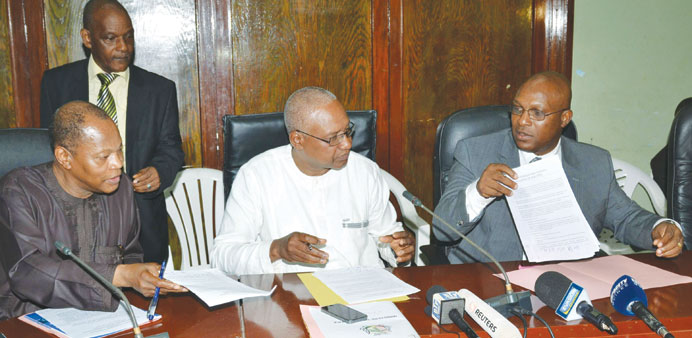
UN special representative for West Africa Mohamed Ibn Chambas, Guinea’s Justice Minister Chieck Sako and Minister-Secretary of the President’s Office Kiridi Bangoura sign an agreement with opposition leaders regarding the organisation of elections, on Thursday in Conakry.
AFP/Conakry
Guinea’s ruling party and the opposition have sealed a hard-won deal on the organisation of October elections, breaking a deadlock which led to deadly violence in the west African nation.
After months of tension the parties agreed late Thursday on the make-up of the electoral commission, an audit of the voters’ roll and to hold talks on a date for local elections, said former prime minister Sidya Toure, head of the opposition Union of Republican Forces (UFR).
“I am very happy that Guinea’s political class has finally signed what we can say, without boasting, is a historic deal,” said Justice Minister Cheick Sako.
Guinea’s presidential election is set for October 11. Local elections—which were cancelled in 2014 due to the Ebola epidemic—were initially rescheduled for 2016.
The holding of local polls after the presidential election angered the opposition, which is convinced Guinea’s local authorities are completely under President Alpha Conde’s control and that he wants them to help rig the presidential vote.
Several opposition protests held since April over the election calendar have turned violent in clashes with security forces, leaving several dead and dozens injured.
In the accord signed late Thursday in Conakry, the parties agreed to carry out an audit of the voters’ roll—which the opposition believes is inflated in areas supporting Conde—at the same time as the presidential election.
The government also agreed to allow the opposition to choose replacements for two members of the electoral commission who died recently.
In addition the parties agreed on the appointment of local government officials in 128 of 335 districts in Guinea, based on the results of 2013 legislative polls.
Guinean towns are currently run by special delegates appointed by Conde as the mandate of elected officials expired in 2010, a decade after the last local polls were held.
However “we are at a stage where we cannot give a new date for local elections,” said Mohamed Ibn Chambas, the UN special representative for West Africa, adding talks on the contentious date would take place at a later stage.
“For peace in the country we decided to make concessions hoping that this time the commitments made will be applied by government,” said opposition leader Cellou Dalein Diallo.
Political distrust is high in the mineral-rich but deeply poor country where ethnic tensions often turn deadly around election time.
Conde became the country’s first democratically-elected leader in a 2010 election that many hoped would put an end to years of dictatorships, coups and political violence.
However his victory over Diallo was marred by election violence and claims of fraud, and the same scenario played out during 2013 legislative polls.
Conde and Diallo come from the country’s two ethnic majorities, the Mandinke and Fulani.
An unlikely political twist has seen Diallo forge an alliance with former army captain Moussa Dadis Camara who seized power in a 2008 coup after the death of long-time dictator Lansane Conte.
Camara’s rule is best remembered for a massacre in September 2009 when security forces opened fire on a crowd protesting the junta, leaving 157 killed and horrific scenes of sexual violence.