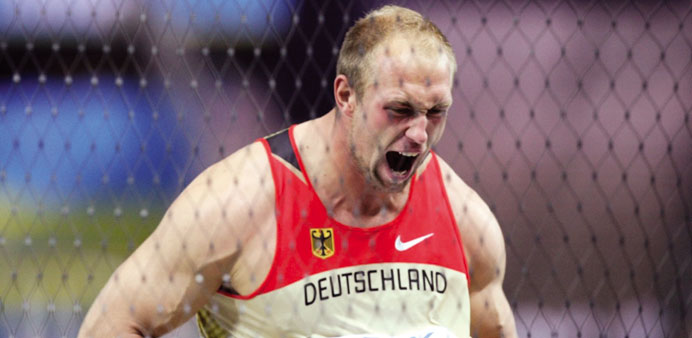
German discus world and Olympic champion Robert Harting is among the athletes who have openly criticised IAAF. “Dear IAAF, we cannot trust you anymore. You damage our sport. We have to act now and this is what we have to say,” he said in a YouTube video.
DPA/Beijing
Athletics is again at the centre of a doping controversy which casts a long shadow over the upcoming World Championships.
Allegations of suspicious blood levels around major event medallists, uncertainty about a probe into doping in Russia and the revelation of 28 athletes with failed tests are causing a huge stir.
The ruling IAAF says it is fighting doping more than any other federation in the world.
But it could also see former cheat Justin Gatlin become world champion in the blue riband 100 metres final on Sunday in Beijing if he continues this year’s trend of running faster than superstar Usain Bolt.
“There is a shadow if our sport is mentioned in connection with doping shortly before the Worlds,” Helmut Digel, an outgoing IAAF council member, said yesterday.
Possibly even more alarming for the IAAF is that some athletes are starting to lose faith in the ruling body.
“Dear IAAF, we cannot trust you anymore. You damage our sport. We have to act now and this is what we have to say,” German discus world and Olympic champion Robert Harting said in a YouTube video.
German TV network ARD and British newspaper the Sunday Times reported recently that a leaked IAAF database with 12,000 blood tests from around 5,000 runners suggests that a third of medallists in endurance events at Olympics and worlds between 2001 and 2012 had suspicious readings.
Digel admitted that the data is “alarming” but also expressed outrage “because the damage for athletics is considerable and implicates many clean athletes.”
The IAAF said the data did not prove cheating and later announced that its anti-doping efforts costing 3 million dollars a year have led to 28 athletes being suspended after retests of samples from the 2005 and 2007 Worlds.
Doping stories are appearing almost on a daily basis, with the Court of Arbitration for Sport on Monday confirming 1,500m Olympic champion Asli Cakir Alptekin of Turkey will lose her London gold and serve an eight-year ban.
But there is so far no news on the progress of an investigation by the IAAF and World Anti-Doping Agency (WADA) on allegations of widespread doping in Russia.
The IAAF is also looking into allegations from another documentary over Alberto Salazar, the coach of double world and Olympic champion Mo Farah.
Farah is not implicated while Salazar says he has not doped athletes.
Former IAAF official Luciano Barra suggested that the “records and riches” philosophy of outgoing IAAF president Lamine Diack has also not helped in the fight against drug cheats.
The doping issue will be a major test for the newly elected IAAF president, either Sebastian Coe or Sergey Bubka.
Both want swifter proceedings and Coe even plans an anti-doping system independent from the IAAF.
“I believe that the IAAF needs to create a completely independent anti-doping system to deal with doping violations committed in international competitions,” he said.
“This would not only simplify the process but also lift the burden placed on member federations and reduce the number of legal appeals slowing down the sanctioning process. Our actions must be aimed at protecting the ambitions of the vast majority of clean athletes.”