


Reuters
Colombo
The exhumation of the remains of a star rugby player whose death is now the target of a murder investigation has cast a shadow over former president Mahinda Rajapakse’s comeback bid at Sri Lanka’s general election next week.
Rajapakse, 69, has denied allegations by the government that Wasim Thajudeen was tortured to death in May 2012 by members of his security team and did not die in a car crash as reported at the time.
“There are no bloodstains on our hands,” the two-term president said after police last week obtained a court order to exhume Thajudeen’s body on suspicion that he had been murdered.
Rajapakse, who has set his sights on becoming Sri Lanka’s next prime minister, said the investigation was timed to coincide with the August 17 elections. He demanded an independent inquiry.
Nobody has been arrested or charged, but the case has received sensational coverage in the local press that could mobilise voters resentful of Rajapakse, who as Sri Lankan leader built a close alliance with China.
“It’s potentially very explosive - it might go right to the top,” said analyst Paikiasothy Saravanamuttu, who runs a policy think tank and election monitoring group.
Although still held in high esteem by much of Sri Lanka’s majority Sinhala community for defeating a 26-year Tamil insurgency in 2009, Rajapakse is reviled by others who accuse him of running a brutal dynastic regime.
According to a poll by Saravanamuttu’s Centre for Policy Alternatives, most minority Tamils and Muslims back prime minister Ranil Wikremesinghe’s reformist coalition.
Rajapakse has a narrow edge among Buddhist Sinhalese - who make up seven in 10 voters on the strategically located Indian Ocean island of 20mn. In a one-on-one premiership contest, Wikremesinghe would have a 10-point lead.
Thajudeen’s remains, wrapped in polythene, were exhumed on Monday on the order of a court to establish whether his injuries were consistent with a police report that his car crashed into a wall on a quiet Colombo side street and caught fire.
Government spokesman Rajitha Senaratne alleged last week that three members of the presidential security guard had tortured and killed Thajudeen, who played for the national rugby side captained by Rajapakse’s second son, Yoshitha.
Officials also allege that the Rajapakse administration suppressed a post mortem report which found that Thajudeen had suffered extensive injuries to his head, neck, pelvis and legs.
The autopsy’s findings were only released after Maithripala Sirisena defeated Rajapakse in a January 8 presidential vote. Following the opening of the murder investigation, Sirisena has fired his security detail.
After seven months of political uncertainty, Sri Lanka will vote in parliamentary elections August 17, as former president Mahinda Rajapakse seeks to regain political power.
The elections were called eight months ahead of schedule after a fragile minority government that ruled since January was brought to the brink of a defeat by a no-confidence motion in parliament.
Rajapakse, 69, who won the civil war over minority Tamil rebels in 2009, is leading the main opposition United People’s Freedom Alliance (UPFA) on a platform of national security.
The popularity he enjoyed from his war-time leadership soon eroded due to his authoritarian rule and stacking the government with close relatives. Political allies turned against him, causing a surprising defeat in his January bid for re-election.
He is now trying to make a comeback by deciding to run for parliament.
Prime minister Ranil Wickremesinghe, 66, is leading the campaign for the ruling United National Party.
Wickremesinghe, a former cabinet minister who broke with Rajapakse, has led a shaky minority government with only 47 members in the 225 seat parliament this year.
President Maithripala Sirisena, another former ally of Rajapakse who challenged and beat him, picked Wickremesinghe to run the government.
They are promising economic development, and dismiss Rajapaksa’s warnings over security as a ploy to stir up old ethnic rivalries.
“The UPFA is making these claims in order to scare the people in the south and get the votes of the Sinhalese majority community,” said minister of public order John Amaratunga.
“There is no threat of the re-emergence of the LTTE [Tamil rebels],”
Neither main party has made much effort to improve the lives of the minority Tamils in the north and eastern regions, where the rebels fought for a separate state in a 26-year civil war.
But Wickremesinghe has pledged to improve reconciliation among ethnic groups, and resolve the grievances of victims of the war. His offer to work with all political parties in a unity government was a broad invitation to Tamil leaders.
“It may be better for Tamil parties to seek help form the government and gain the development needed for the north, instead of staying out and complaining,” says Sridharan Jayasangar, a politician in the northern region.
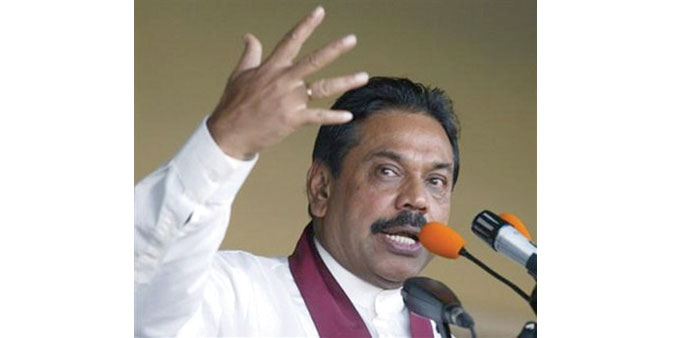
Mahinda Rajapakse