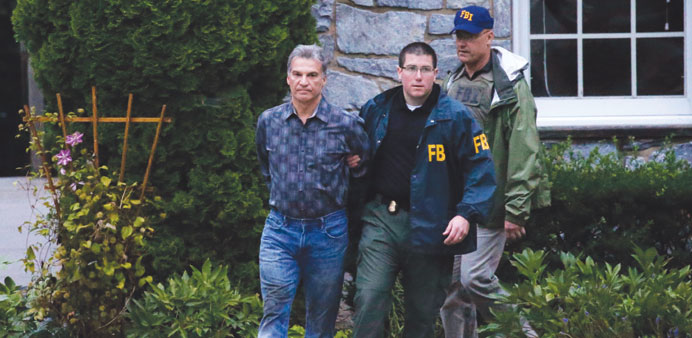
Vitaly Korchevsky is escorted in handcuffs from his home by FBI agents in Glen Mills, Pennsylvania, yesterday. Korchevsky was one of several men arrested in the biggest case of insider trading linked to the fast-growing threat of global cybercrime.
Bloomberg/New York
He seems like an American success story: an ambitious Russian who came to the US and went from business school to Wall Street to his own hedge fund.
But somewhere along the way, US authorities say, Vitaly Korchevsky began orchestrating a new type of financial crime.
Korchevsky, 50, was one of several men arrested yesterday morning in the biggest case of insider trading linked to the fast-growing threat of global cybercrime. Charges against him were unsealed yesterday in Brooklyn, New York federal court.
The alleged scheme stretched from the affluent suburbs of Philadelphia, where Korchevsky ran a small investment fund, to the darkest realms of the Internet.
Working from Russia or Ukraine, hackers infiltrated several computer systems used by Corps to report sensitive information like earnings and then, allegedly with Korchevsky’s help, made millions of dollars trading on the confidential data, people familiar with the matter say.
Little that is known about Korchevsky seems to hint at his alleged role in bringing together these two illicit worlds. Less than prominent in financial circles, he has spent a decade and a half moving from one mid-level job to the next.
After completing university in Russia, Korchevsky collected an MBA in 1995 from Regent University, a private Christian institution founded by the televangelist Pat Robertson. He also received his Certified Financial Analyst charter, considered the gold standard among financial professionals.
By 1999 he was working in the asset management division of Morgan Stanley, where he helped manage several Invesco American Value funds, according to Morningstar. From there he joined Victus Capital in New York and then Investment Counselors of Maryland in Baltimore. He left in 2009, two years before registering his own hedge fund, NTS Capital Fund, in Glen Mills, Pennsylvania.
Other than traffic violations, Korchevsky’s US legal record appears clean, as is his official Wall Street record filed with the Financial Industry Regulatory Authority.
In an era of high-profile Wall Street scandals, the scheme laid out by prosecutors is relatively small in dollar terms. Authorities say the perpetrators made approximately $30mn in illicit profits — a pittance next to the epic Ponzi scheme masterminded by Bernard L Madoff. The insider trading scheme hatched by Galleon Group co-founder Raj Rajaratnam netted about $72mn.
Nonetheless, the confluence of computer hacking and insider trading raises the stakes for investors and federal authorities.
Thought to be in Ukraine and possibly Russia, the hackers infiltrated the computer servers of PRNewswire Association, Marketwired and Business Wire, a unit of Warren Buffett’s Berkshire Hathaway, according to a person familiar with the matter. They stole more than 150,000 press releases over the duration of the scheme.
They then allegedly fed the information to Korchevsky and others in the US who used it to buy and sell shares of dozens of big companies, including Panera Bread Co, Boeing Co, Oracle Corp, Hewlett-Packard Co and Caterpillar, ahead of the news.
The defendants traded in personal brokerage accounts and then siphoned the money offshore through Estonian banks, the person said.
Korchevsky was taken into custody at his home in Glen Mills, where he operated NTS Capital. NTS has made no filings since its initial one four years ago, and it’s unclear if the fund is still in operation. Korchevsky is now facing securities fraud and conspiracy charges by federal prosecutors in Brooklyn.