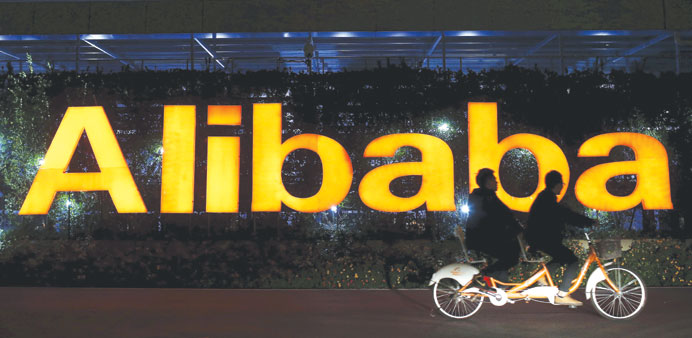
People ride a bicycle past the Alibaba headquarters near Hangzhou, Zhejiang province. Alibaba has been seeking to strengthen its electronics offerings in recent years, inking tie-ups with Gome Electrical Appliances Holding and Haier Electronics Group to offer home appliances online.
Reuters/Beijing
Alibaba Group Holding will invest $4.6bn in leading Chinese electronics retailer Suning Commerce Group, its biggest step yet towards integrating online and store-based shopping.
Alibaba is paying 28.3bn yuan ($4.56bn) for newly issued Suning shares and will ultimately hold a 19.99% stake. Suning will in turn invest 14bn yuan to acquire 1.1% of Alibaba through the purchase of new shares, the companies said in a joint statement.
The deal comes when Chinese companies, as well as the country’s top policymakers, have espoused combining offline and online sectors as a lucrative new business model.
Baidu Inc, China’s dominant Internet search provider, has said it would invest $3.2bn over the next three years in such services, while property conglomerate Dalian Wanda Group said last month its entertainment arm would lead a $1bn investment in a travel website.
Alibaba’s latest alliance would, in practical terms, allow its online customers to go into one of Suning’s 1,600 outlets in China to try out a product before purchasing it on Alibaba’s website using their smartphone.
Suning, which has long boasted a formidable logistics operation, would join forces with Alibaba’s distribution network to deliver goods in as little as two hours, the companies said.
China’s leaders have been fleshing out a broad Internet sector strategy known as “Internet Plus” to combine online and offline industries and encourage more technology-driven, high-value economic output as the world’s second-largest economy wrestles with slowing growth. For Alibaba, the alliance could reinforce its position against its main e-commerce rival JD.com, which has traditionally enjoyed healthy sales of electronics and gadgets. Alibaba will open a new section dedicated to Suning on its popular TMall shopping website.
Alibaba has been seeking to strengthen its electronics offerings in recent years, inking tie-ups with Gome Electrical Appliances Holding and Haier Electronics Group Co to offer home appliances online.
Speaking to reporters yesterday, Alibaba chief executive Daniel Zhang said he would consider striking more deals with brick-and-mortar stores beyond electronics, as long as those retail chains “can bring us additional customers.”
But he maintained that Alibaba’s interest in Suning did not reflect any fundamental shift in Alibaba’s strategy towards becoming more of a physical retailer itself.
“We are trying to build an integrated online-offline platform for both customers and merchants,” Zhang said. “We don’t change our strategy. We’re still a platform company.”
Alibaba’s Tmall faced challenges holding onto its long-held dominance in Chinese e-commerce, said James Roy, associate principal from China Market Research Group in Shanghai.
“From Alibaba’s point of view, acquiring or having such a strategic alliance with a fairly large competitor will help them to continue to enjoy that strong position.”
JD.com played down its rival’s new partnership.
“Over 12 years we’ve built a reputation for amazing delivery speed and attention to customer experience. That’s why we’ve been able to build a market leading position, and it’s very tough to duplicate,” JD.com said in a statement.