


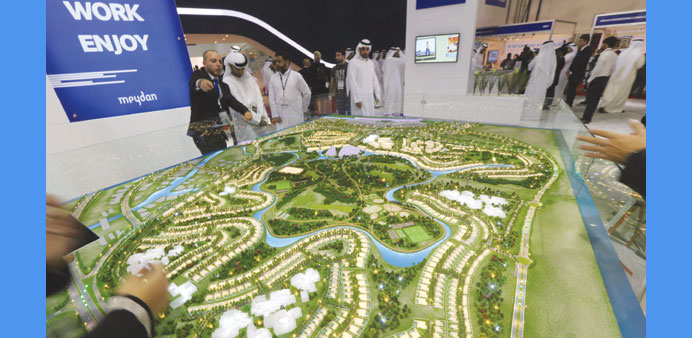
People look at a construction model by Meydan Group at a Cityscape Global show in Dubai (file). Dubai’s real estate transactions dropped 47% in the first half from a year earlier and prices have declined by 8% since June 2014, according to property researcher Jones Lang LaSalle. Despite the sales slump, Dubai’s developers continue to unveil megaprojects. State-controlled Meydan this month announced the approval of Meydan One, which includes homes for more than 78,000 residents, the world’s tallest residential tower and the longest indoor ski slope.
Bloomberg/Dubai
The jagged hole that used to be the glass front door of Dubai’s S&K Estates Agents sums up the state of the city’s home-selling business.
Someone smashed the entrance after the company known as Smith & Ken shut down its offices overnight, citing a “drastic” drop in first-half revenue. The dearth of deals that sparked S&K’s collapse and the loss of 80 jobs is likely to cause more pain in the Middle East’s biggest and most volatile property market.
Dubai’s property brokers, some of whom earned more than $50,000 a month when real estate was booming a couple of years ago, are struggling as prices fall and deals dry up. With more than 5,500 real estate agents closing 7,400 purchases in the first half, there’s not enough business to go around.
“All real estate brokerages, large or small, are feeling the pinch,” said Mario Volpi, former managing director of Ocean View Real Estate who’s joining a company focused off-plan sales this week. “Advertising costs are still high, while income is falling. With so few sales being concluded, something has to give.”
Transactions dropped 47% in the first half from a year earlier and prices have declined by 8% since June 2014, according to property researcher Jones Lang LaSalle Inc. Brokers say they generally don’t receive a monthly salary, so there’s no cushion when sales commissions don’t come in.
Over the past decade, Dubai’s property market has swung from boom to bust and back again. Price gains in the two years through 2014 had recouped much of the losses incurred in a 2008 collapse that pushed the city to the brink of bankruptcy.
The market dropped again this year, hurt by falling oil prices, weaker currencies in Europe and Russia and oversupply. Regulators also introduced caps on the size of mortgages. Values may drop by as much as a fifth this year, Standard & Poor’s estimated. Brokers CBRE Group and JLL have predicted a 10% decline.
“New government regulations on real estate brokers and developers has brought new challenges,” said Ian Albert, regional director for Colliers International. “With that, hopefully we will see greater levels of professionalism in the industry.”
A total of 2,363 property brokerages are registered with the Dubai Land Department. It didn’t provide information for previous years. Many unregistered agents also operate. Real estate and business services accounted for 13.3% of Dubai’s gross domestic product in 2014, the fourth-largest contributor, according to the emirate’s statistics centre.
“Real estate brokers’ fate is inevitably linked to the price level and number of transactions,” said Philippe Dauba-Pantanacce, senior Middle East, North Africa and Turkey economist at Standard Chartered Plc in London. “We are not in the same situation as in 2009. Macro prudential measures have been put in place, speculative investments have been tamed, real demand is more driving the cycle now.”
The Dubai Financial Market Real Estate & Construction Index, which tracks seven companies in the emirate, has risen 5.4% this year compared with a 61% surge during the same period last year.
Despite the sales slump, Dubai’s developers continue to start the kind of megaprojects that put the Gulf emirate on the map. State-controlled Meydan City Corp this month announced the approval of Meydan One, which includes homes for more than 78,000 residents, the world’s tallest residential tower and the longest indoor ski slope.
“The real estate sector is a vital driver of growth in Dubai and its importance is greater than the direct size reflected in GDP data,” said Monica Malik, chief economist at Abu Dhabi Commercial Bank. “It’s a critical component of the investment programme, impacting private-sector confidence and spending.”
S&K shareholders said in a statement that falling revenue amid plummeting prices led to a drop in transactions that forced it to file for bankruptcy on July 21. The offices were shut down seven days later. Remnants of the smashed door remained attached to the hinges at the front of the 11th-floor offices around a temporary wooden door that has been put in its place.
S&K generated as much as 4mn dirhams ($1.1mn) in revenue monthly when prices were soaring in 2013, according to a former employee who asked not to be identified because the information is private. Revenue fell to about 1mn dirhams a month before S&K closed, two former staff members said.
The workers weren’t warned about the closure and many workers only found out when they turned up for work on July 22, the former employees said.
S&K chief executive officer Benjamin Smith didn’t immediately respond to a request for an interview on social media.