


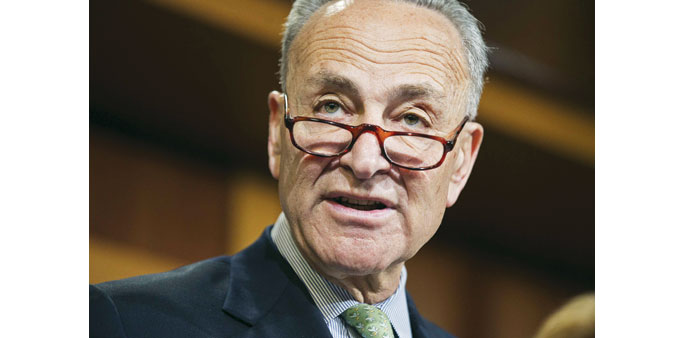
The US Congress has until September 17 to consider a resolution of disapproval of
the Iran deal
Reuters
Washington
US President Barack Obama’s hopes of preserving the nuclear deal between Iran and world powers were dealt a setback yesterday when Chuck Schumer, one of the top Democrats in the US Senate, said he would oppose the agreement.
Schumer’s opposition, announced in a lengthy statement, could pave the way for more of Obama’s fellow Democrats to come out against the nuclear pact, announced on July 14, between the US, five other world powers and Iran.
The New York senator is among the most influential Jewish lawmakers in the US. He was the first Senate Democrat to announce his opposition to the agreement.
Another influential Jewish lawmaker, US Representative Eliot Engel, the top Democrat on the House of Representatives Foreign Affairs Committee, also said he would oppose the nuclear pact in a statement obtained by Reuters.
Israeli Prime Minister Benjamin Netanyahu has been pushing lawmakers to oppose the nuclear agreement. Some pro-Israel groups have also been spending millions of dollars on an advertising campaign to push members of Congress to vote “no.”
Obama has been engaged in his own lobbying effort, including a combative speech on Wednesday in which he said abandoning the agreement would open up the prospect of war.
Speaking at a news conference on a visit to the Vietnamese capital, Hanoi, US Secretary of State John Kerry, who negotiated the deal on the US side, said he respected Schumer and Engel but added that “rejection is not a policy for the future”.
“It does not offer any alternative and many people in arms control and others have actually pointed that out. While I completely respect everybody’s individual right to make a choice, I obviously disagree with the choice made,” he said.
The US Congress has until September 17 to consider a resolution of disapproval of the Iran deal, which would eliminate Obama’s ability to waive all sanctions on Iran imposed by the US Congress, a key component of the agreement.
Lawmakers will begin debating whether to reject the deal when they return from their August recess on September 8.
Schumer insisted he was not influenced by party or politics and had not been pressured.
“Advocates on both sides have strong cases for their point of view that cannot simply be dismissed. This has made evaluating the agreement a difficult and deliberate endeavour, and after deep study, careful thought and considerable soul-searching, I have decided I must oppose the agreement and will vote “yes” on a motion of disapproval,” he said.
Obama has promised a veto if the resolution is passed by the House and Senate.
Republicans would need at least 13 Democrats in the Senate and 44 in the House to vote against Obama to muster the two-thirds majorities in both chambers needed to override a veto. So, while the latest announcements are a blow to the president, opponents of the deal still face an uphill battle to enact a disapproval resolution.
Several Democrats in the House and Senate have already come out in favour of the nuclear deal, including Nancy Pelosi, the House Democratic leader. Schumer’s colleague from New York, US Senator Kirsten Gillibrand, announced her support on Thursday and on Democratic Senator Tammy Baldwin yesterday released a statement saying she would back the agreement because it “will best serve America’s national security interests”.
A handful of House Democrats in addition to Engel have said they oppose the deal, including Representative Steve Israel, a member of the chamber’s Democratic leadership.
Schumer said lawmakers would come to their own conclusions but that he would try to persuade other senators to vote against the Iran deal. Schumer is currently the No 3 Democrat in the Senate and is in line to succeed Harry Reid as the party’s leader in the chamber when Reid retires in early 2017.
A congressional aide said Engel would vote for a resolution of disapproval and also vote to override an Obama veto if the resolution passed Congress. However, Engel did not say he would lobby against the deal among other lawmakers.
Schumer’s opposition was first reported by the Huffington Post. He said in his statement he opposed the nuclear deal because he believed Iran would not change and that the deal would let it eliminate sanctions while retaining “nuclear and non-nuclear power.”
“Better to keep US sanctions in place, strengthen them, enforce secondary sanctions on other nations, and pursue the hard-trodden path of diplomacy once more, difficult as it may be,” Schumer said.
White House shrugs off Schumer’s decision
The decision by one of the top Democrats in the US Senate to oppose the nuclear deal between Iran and world powers was “disappointing but not surprising,” White House spokesman Josh Earnest said yesterday. Earnest told reporters in Washington, DC that the Obama administration worked closely with New York’s Chuck Schumer to explain details of the deal even before it was signed in an effort to gain his support.
“Ultimately, it didn’t turn out that way. I don’t think anybody was surprised,” Earnest said.
Twelve members of the US Congress, seven members in the House of Representatives and five in the Senate, have publicly come out in support of the agreement in recent days, showing Obama had made a persuasive case, Earnest said. The administration is confident they can continue to build support before next month’s deadline, he added.