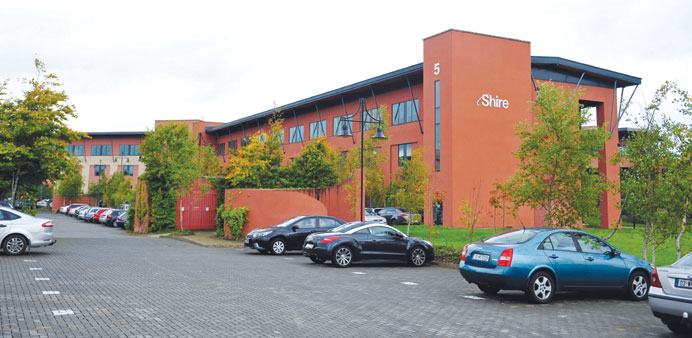
A view of the Shire headquarters at the Citywest Business Campus in Dublin. Shire says a combined company with Baxalta would generate $20bn in sales by 2020 with new drugs for ailments ranging from dry eye disease to haemophilia.
Bloomberg/London
Shire made an unsolicited offer to buy one-month-old Baxalta for about $30bn in stock to bolster its focus on rare diseases, a move that may fend off larger drug makers looking at its own assets for a tax break.
Baxalta, a business spun off by Baxter International last month, rejected Shire’s offer of about 0.1687 American depositary receipts for each share held. The proposal values the target company’s stock at $45.23, a 36% premium over Tuesday’s close. Baxalta jumped 12% to $37.10 in New York, while Shire slumped.
The Dublin-based company, which has been the target of speculation over the past year as a potential fit for bigger pharmaceutical companies seeking the benefits of tax-inversion deals, approached Baxalta weeks ago. Baxalta on July 31 declined to engage in negotiations. The combined company would generate $20bn in sales by 2020 with new drugs for ailments ranging from dry eye disease to haemophilia, Shire said.
“Your lack of engagement has been surprising,” Shire chief executive Officer Flemming Ornskov wrote in a letter dated August 4 to to his counterpart at Baxalta, Ludwig N Hantson.
“As a result, you have left us with no choice but to make our proposal known to your shareholders. We believe they deserve an opportunity to consider it.”
In a statement, Baxalta said it had already rejected the proposal when it was presented privately by Shire on July 10. The price isn’t high enough for a company that is just starting out on its own, it said.
“A merger at this time would be severely disruptive at this very early stage of Baxalta’s existence as a public company and presents a significant and real risk to value creation for our shareholders,” Baxalta chairman Wayne T Hockmeyer said.
Baxalta, based in Deerfield, Illinois, would benefit from a lower tax rate by being taken over by a UK company. The US drug maker had projected a tax rate of 23% to 24% for the second half of this year. A combination with Shire would yield an effective tax rate of 16% to 17%, Shire said in its statement.
Together, Shire and Baxalta would be “the leading global biotech company in rare diseases,” according to Ornskov.
Rare-disease treatments have become one of the hottest properties for drug makers because of the potential for high-priced products and incentives offered by regulators including tax breaks and seven years of market exclusivity. The FDA defines rare diseases as those that affect fewer than 200,000 people in the US
Shire, which is seeking to boost growth after a proposed $52bn sale to AbbVie collapsed last year, expanded its portfolio of rare-disease treatments in February with the purchase of NPS Pharmaceuticals, gaining a medicine for short bowel syndrome. Baxalta derives about about half of its sales from haemophilia, a rare bleeding disorder.
“From a rare disease point of view, it does seem to make sense,” said Klara Fernandes, an analyst at Berenberg Bank in London.
Evercore Partners Inc and Morgan Stanley are advising Shire and Ropes & Gray along with Slaughter & May are acting as legal counsel.
Shire shares fell 5.9% to 5,395 pence in London. The stock had climbed 18% in the past year through Monday.
The company is registered in Jersey, in the Channel Islands, and based for tax purposes in Ireland. Its primary stock listing is in the UK, while Ornskov and most other top executives are based in Lexington, Massachusetts.