Reuters/London
Emerging stocks languished near a two-year low yesterday after Chinese shares took another beating while currencies, mired around multi-year lows, were pulled in different directions by the rising dollar and falling oil prices.
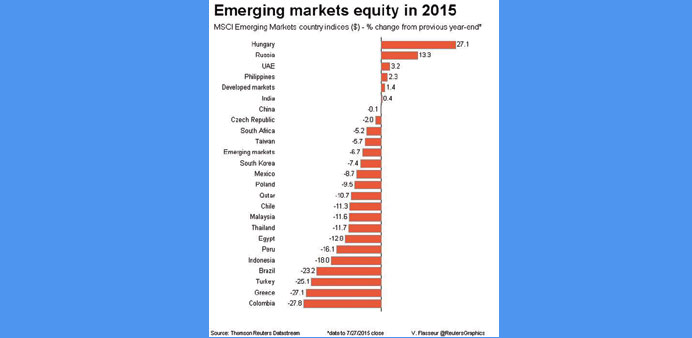
MSCI’s emerging market stock index was flat after Chinese shares closed down 1.7% with Beijing scrambling again to prop up markets whose wild fluctuations have heightened fears over China’s financial stability.
After a plunge of more than 8% in major indexes on Monday, Chinese regulators said they were prepared to buy shares, while the central bank injected cash into money markets and hinted at further monetary easing.
“It shows the limitations to what the authorities can achieve and raises concern about how they will manage the other challenges in the economy,” UBS strategist Manik Narain said.
“Despite the correction we’ve seen ... it’s still an expensive market and retail-driven speculation has not been fully removed from prices yet.”
Meanwhile, oil prices fell some 2% on concerns of oversupply, hurting commodity exporters.
In Russia, the hit was compounded by data showing the economy had contracted by 4.2% in June from a year ago, which sent the rouble crashing through the 60-to-the-dollar level it last broke on March 20.
Dollar-denominated stocks fell 0.7% with both the rouble and stocks easing for the fifth straight session.
“The theme of weaker growth which is impacting emerging market stocks and currencies still seems to be one the market is very concerned about,” UBS’s Narain said.
Investors’ concern pushed the spread of JP Morgan’s benchmark emerging market bond index over safehaven US Treasuries to its widest in more than four months.
Weaker oil prices also weighed on Gulf stock markets, with Dubai, Qatar and Abu Dhabi all lower.
The dollar recovering some of Monday’s falls and rising 0.2% put pressure on currencies.
Malaysia’s ringgit stayed close to 17-year lows against the greenback while the Thai baht also weakened.
The Turkish lira rose 0.2% and shares gained 0.6%, both rising from seven-week lows hit on Monday after Ankara’s dramatic turnaround to join the US-led coalition against Islamic State and attack Kurdish insurgent camps in a campaign that could end its peace process.
South Africa’s rand rose 0.4%, bouncing off a 14-year trough hit in the previous session.
Across Central and Eastern Europe, currencies traded chiefly flat against the euro, though the Polish zloty, the region’s most liquid currency, eased 0.2%.