


AFP/Reuters/Budapest
Hungary will finish building its anti-migrant fence on its southern border with Serbia by August 31, ahead of a previous November deadline, Prime Minister Viktor Orban said yesterday.
“The fence will be built by August 31, any schedules different from that are invalid,” Orban told an audience at a Hungarian-language summer university in Baile Tusnad in Romania, according to Hungarian state news agency MTI.
Work began last week on a short test section of the 4m-high (12 feet) fence, a bid to stem a surge in 2015 in the number of migrants and asylum-seekers crossing into Hungary from Serbia.
Last week, Hungary’s defence and interior ministers said the wire-mesh barrier would be completed along the entire 175km (110-mile) length of the border by November.
So far this year, Hungary has registered more than 80,000 asylum-seekers, up from 43,000 last year and just over 2,000 asylum applications in 2012.
Most come from Afghanistan, Iraq, Syria and African countries, and hope to cross into Austria and Germany or further west.
Unlike its neighbour to the south, Hungary is an EU member and is also in the bloc’s passport-free Schengen zone which means that once migrants are inside the country, they can easily travel elsewhere.
The fence plan, one of a series of hardline anti-migration measures launched by Orban, has caused alarm in Serbia, although Belgrade has conceded that Hungary has the right to protect its own borders as it sees fit.
The Hungarian parliament recently toughened asylum application rules, and allowing for the detention of migrants in temporary camps.
Last week, Hungary also declared Serbia a “safe country” which can allow it to quickly deport asylum-seekers.
Orban said yesterday that illegal immigration is linked to terrorism, and also leads to increases in crime, including rape, and unemployment.
“There is a clear link between illegal migrants coming to Europe and the spread of terrorism,” Orban said in an annual speech in Romania, where he usually outlines his political vision for the coming years. “It is obvious that we simply cannot filter out hostile terrorists from this enormous crowd.”
“Our answer is clear: we would like to preserve Europe for Europeans ... and this also requires an effort from other (countries),” Orban said. “But there is something that we would not only like but we want: to preserve Hungary for Hungarians.”
Orban, whose Fidesz party is losing ground to Hungary’s far-right, eurosceptic, anti-immigrant Jobbik party, said the “human rights fundamentalism” of the West provided moral encouragement to migrants.
EU policies were not robust enough to defend its own citizens from the threats posed by rising immigration, he said.
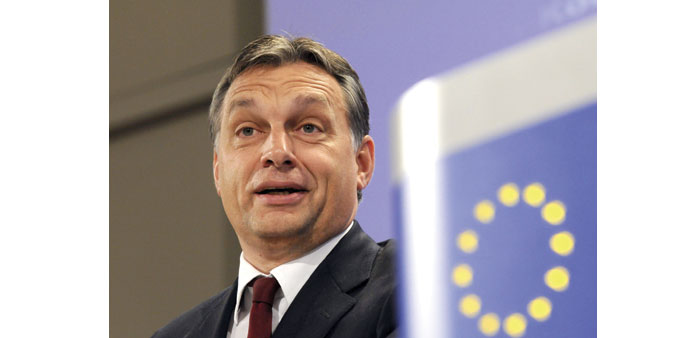
Orban: We would like to preserve Europe for Europeans.