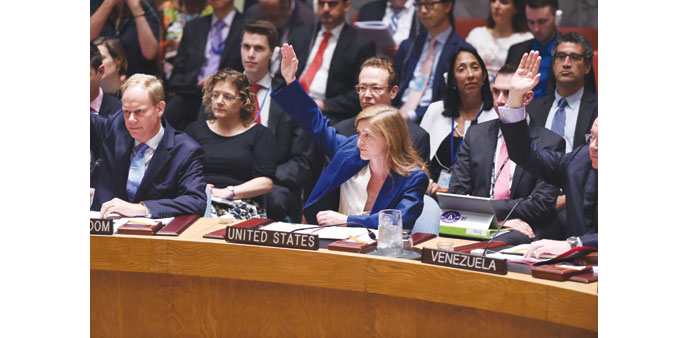
US ambassador to the United Nations Samantha Power, centre, votes along with other Security Council members on the Iran resolution at the UN headquarters in New York on July 20. The UN Security Council on Monday unanimously adopted a resolution that will clear a path for international sanctions crippling Iran’s economy to be lifted. Representatives of all 15 countries on the council voted by raising their hands.
By Rekha Basu/Des Moines Register/TNS
Ambassador Ryan Crocker is no shill for this president or any president. Having served as ambassador to Iraq under both George W Bush and Barack Obama, the retired diplomat faults the former for plunging the US into the Iraq war and the latter for pulling troops out too soon.
But Crocker, who seems to embrace diplomacy at a cellular level, sees last week’s agreement to prevent Iran’s development of nuclear weapons as history in the making.
“The world is not the same since yesterday morning,” he told journalists the day after the deal was struck. “There has never been an agreement of this depth, magnitude or complexity with an aspiring nuclear power.”
Moments earlier, Obama had faced sceptical questioning over a pact he had prodded Iran and five other nations - China, France, Germany, Russia and the United Kingdom - to agree upon. It took nearly two years to hatch. The president said it offers a peaceful resolution to a global problem while showing American strength and leadership.
One reporter suggested the president was hanging American detainees out to dry while rejoicing over a deal with their captor. The Israeli prime minister was trashing the treaty.
Republican presidential candidates variously suggested the president was naive for agreeing to let go of sanctions and trust Iran.
The criticisms centre more on what the treaty doesn’t do than what it does, and on the more existential idea that you don’t make deals with an enemy. But this deal is in fact remarkable for what it didn’t have to do to accomplish something of paramount importance to the US and the world. It doesn’t normalise relations between the two countries. Obama noted Iran’s funding and use of proxies to destabilise parts of the Middle East. He stressed that US sanctions over human rights violations and other issues will continue. But he expressed hope that the countries could build on the deal, and it would give Iran incentives to co-operate in the region.
In exchange for the lifting of international economic sanctions, Iran commits to using nuclear technology only for peaceful purposes. It cuts by 98% its low-enriched uranium and by two-thirds the number of centrifuges that can be used to enrich the processed fuel.
If it does those things, experts say it would take Iran a year to amass the materials to make a nuclear bomb, should it decide to break the agreement. Right now, it could take two to three months. The president said there would be 24-hour electronic monitoring of key nuclear facilities by the International Atomic Energy Agency and sanctions if Iran violates terms.
The international arms embargo against Iran will continue for five years, and the transfer of ballistic missile technology for eight.
It’s far from perfect, but it makes the world safer than it would have been. And maybe more important, it shows the potential for finding areas of shared interest and collaboration even between opponents.
It takes a diplomat to drive that point home. Having represented the US in such trouble spots as Afghanistan, Syria, Pakistan and Lebanon and been the first director of governance for the Coalition Provisional Authority in Iraq, Crocker stresses the importance of empathy. Not to be confused with sympathy, he said it means putting yourself in the other one’s shoes and understanding their motivations, pressures and fears.
Looked at through that prism, the Iranian government has a strong incentive to uphold the agreement because Iranians have been badly hurt by sanctions, and loathed at being treated as outcasts. Yet there were hardliners to deal with, just as there are here.
No opponent of the deal has actually offered a credible alternative other than vague allusions to military action and going it alone. Crocker believes there were no good alternatives. He said the military option would have required 30,000-pound bombs to be repeatedly dropped to end Iran’s nuclear programme. There is no international will to “double down on sanctions”. And in practical terms, “the essence of Iran’s nuclear capability is nothing physical. It’s the knowledge. ... This agreement won’t permit them to exercise it”.
Maybe diplomacy won’t always succeed but it’s counterproductive to brand some countries America’s enemies, make unilateral demands of them and refuse to talk to them. From nuclear proliferation to global warming, our fates are increasingly interdependent, and it may be a matter of coming up with the right incentives.
From full engagement to disengagement, Crocker says we’ve been “all over the map” politically and diplomatically. Now it’s time to hone in on “our place in the world”.
♦lRekha Basu,a columnist for the Des Moines Register, may be contacted on her email at [email protected]