Reuters/Zurich
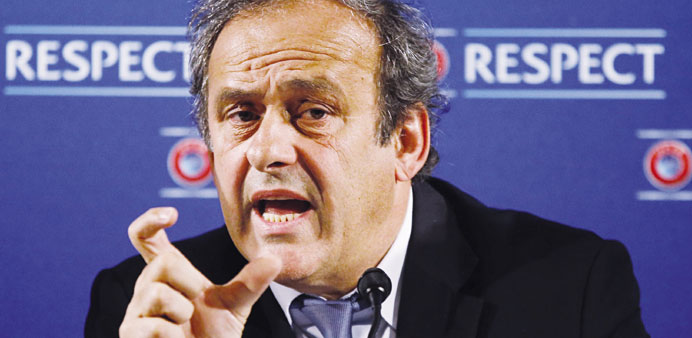
One of the most exquisitely gifted soccer players of his generation, Michel Platini likes to portray himself as an old-fashioned romantic with a mission to maintain the game’s purity.
As he now ponders a bid for the presidency of soccer’s world governing body FIFA, however, some may wonder whether the moody Frenchman, one-time midfielder, is the right man to clean up an organisation mired in a graft scandal reaching its top echelons.
Platini, 60, formerly a protege of FIFA president Sepp Blatter who has now turned into one of his biggest critics, has been outspoken in his criticism of the corruption allegations.
“I am the first one to be disgusted by this. I have stomach trouble when I think about the FIFA problem,” he said in May.
With eight years experience as UEFA president, he may have some strong ideas about how to reform the organisation when Blatter steps down in February.
Yet, he has said little about what should be done to weed out corruption in FIFA. His record at UEFA, however, gives clues to how he would handle the future of a game that embraces all continents, a sport that has become a huge global business.
One of Platini’s first moves at UEFA was to introduce a two-tier qualifying system for the flagship Champions League, making the lucrative group stage more accessible to clubs from eastern Europe and lower-ranked European countries.
He resisted pressure to introduce technology to help with refereeing decisions, instead preferring an innovative system of extra officials on each goal line.
Other UEFA policies have shown a less romantic, less ‘purist’, more businesslike side to Platini.
Some critics have accused him of turning UEFA into a slick, financially successful and yet ultimately charmless organization, where elite clubs have thrived and others have to sell their best players to stay afloat.
Under his leadership, UEFA has steered money and power to precisely the clubs and leagues that are already the most established, particularly through the market pool system where club revenue depends on the size of their country’s television market.
Another controversial policy was the introduction of UEFA’s complicated Financial Fair Play rules, a system yet to be proven to really achieve its aims.
Platini the pragmatist knows he cannot afford to upset the powerful European clubs who have formed their own organization, initially known as the G-14 and now expanded to the European Clubs’ Association (ECA), to look after their interests.
He also has to keep Europe’s smaller national federations happy as they hold the votes in UEFA elections.
Pedro Pinto, UEFA’s spokesman, said that Platini stood by his decisions even though it left him vulnerable to criticism.
“He’s a man of conviction, he’s a man who has always been transparent and one of the few, if not the only one, to admit who he voted for,” he said.
“He has nothing to hide and is someone who I think is respected around the world of football.”