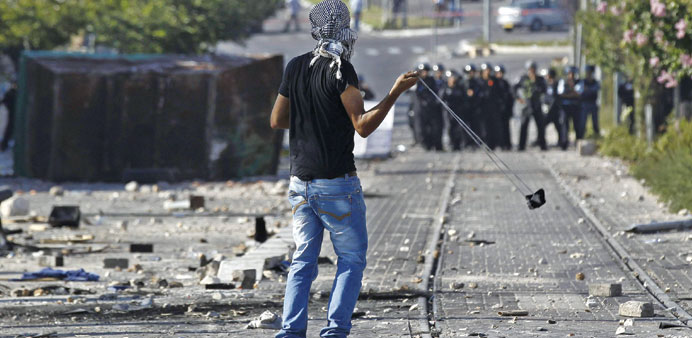
A Palestinian uses a sling to throw stones towards Israeli police during clashes in Shuafat, an Arab suburb of Jerusalem, in this July 4, 2014 file photo.
Agencies/Jerusalem
Israel’s parliament imposed tougher penalties of up to 20 years prison for people throwing stones at vehicles and roads, a move one Palestinian official branded racist and excessive.
Lawmakers voted 69 to 17 to increase the punishments late on Monday, approving legislation proposed after a wave of Palestinian protests last year in East Jerusalem.
“Tolerance toward terrorists ends today. A stone-thrower is a terrorist and only a fitting punishment can serve as a deterrent and just punishment,” Israel’s Justice Minister Ayelet Shaked, of the far-right Jewish Home party, said in a statement.
Confrontations between Palestinian youths and Israeli police routinely degenerate into violent clashes, and stone-throwing has been a symbol of Palestinian resistance since the first Palestinian uprising, or Intifada, against Israel in the late 1980s and early 1990s.
Since 2011 three Israelis, including a baby and a girl, have been killed in the occupied West Bank after rocks were thrown at vehicles they were in.
Human rights groups have criticised Israel for using excessive force including live fire in suppressing Palestinian demonstrations, causing dozens of deaths and hundreds of injuries.
The new law allows for a sentence of up to 20 years in jail for throwing a rock at a vehicle with the intent of causing bodily harm and 10 years in prison if intent was not proven.
Prosecutors in such cases have usually sought sentences of no more than three months in jail when the offence does not result in serious injury.
Qadura Fares, head of the Palestinian Prisoner Club, an organisation that advocates on behalf of Palestinian prisoners in Israeli jails, said the new law was “racist”.
“This law is hateful and contradicts the most basic rule that the punishment fit the offence,” he said.
The law would cover territory including East Jerusalem, but not the occupied West Bank, most of which is under the jurisdiction of the Israeli military.
Israel hands down about 1,000 indictments a year for rock-throwing, according to the Knesset.
Prime Minister Benjamin Netanyahu’s right-wing government faced growing calls to take action after the Palestinian protests in 2014 over the Gaza war and the burning alive of a Palestinian teenager in a suspected revenge attack for the killing of three Israeli teens by Palestinian militants.
During the protests, stones were regularly thrown at the city’s light railway.
The new legislation was originally promoted by Shaked’s predecessor, centrist Tzipi Livni.
The Palestinians seek a state in East Jerusalem, the West Bank and Gaza Strip. US-brokered peace talks between Israel and the Palestinians broke down in 2014.
l Jihadists in the Gaza Strip have threatened to fire rockets at Israel in response to a Hamas crackdown on extremists in the Palestinian territory.
The threat came in reaction to the arrest of militants suspected of targeting members of Hamas’s armed wing on Sunday with a series of bombings.
“The Salafists have decided to respond to these crimes and these blows dealt by Hamas by pointing rockets towards the occupation (Israel) and carrying out reprisals,” said a statement released online late Monday.
Hamas police arrested a dozen “mujahedeen” after Sunday’s explosions, which destroyed five cars.
The jihadist statement accused Gaza’s rulers of staging the blasts as an excuse to crack down on Salafists.
“The results will be catastrophic, will benefit no one, and it will be Hamas who shoulders the responsibility,” it said.
Israel holds Hamas responsible for any rocket fire at the Jewish state from the coastal enclave.
The military struck Hamas facilities in Gaza last week after militants fired a rocket into southern Israel.
Hamas is engaged in a power struggle with smaller extremist groups.
On Sunday, five near-simultaneous explosions targeted members of the armed branches of Hamas and Islamic Jihad, another Islamist group.
There was no immediate claim of responsibility for the blasts that rocked an area in Gaza City.
A series of such attacks in recent months is suspected to have been carried out by Salafists, some of whom claim links with the Islamic State group, although experts have expressed doubts over whether there are any true ties between them.
Gazans who have gone to fight with IS in Syria recently released a video calling for Hamas to be toppled. Salafist groups have claimed in recent weeks that around 100 of their members or supporters were behind bars.
They also criticise Hamas for what they see as its lack of zeal in enforcing Islamic law as well as for its truce with Israel since last year’s war in Gaza.