


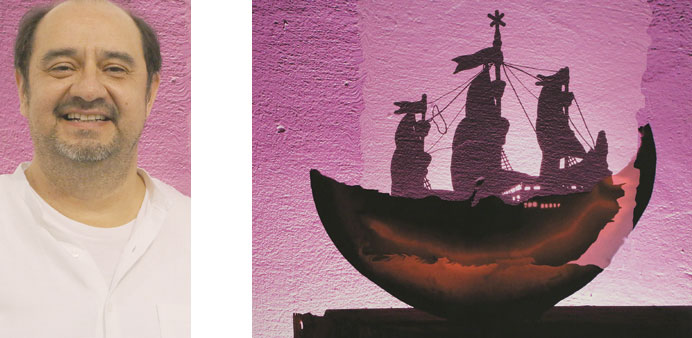
DIFFERENT: Juan Ramirez has been conceiving ideas on canvas with his digital prints for years.
Photos by Umer Nangiana
If the world is a stage, for Mexican photographer-artist Juan Ramirez, the
actors are watermelons. He has carved dozens of stories from the fruit
spanning decades. Here, he gives Umer Nangiana food for thought
Who doesn’t love to devour them, but how many would conceive shapes and characters in watermelons?
Juan M. Ramirez, a Mexican expatriate and photographer and artist based here in Doha, for one, does. A watermelon literally, is his ‘food for thought’ and why, even muse for artwork!
If the world is a stage, for Ramirez, the actors are watermelons. However, his work goes beyond just taking shots of watermelons.
Honed on photography, Ramirez creates ideas and tells stories through pictures taken in digital prints which feature watermelons as models, and objects. An architect and interior designer by profession, the Mexican artist has been creating dozens of such stories spanning decades.
Two of his works — a sailor’s life story and the photographic commentary on the ancient idea of the earth being flat, are on display at the Katara Art Centre (KAC) building 5 alongside five other artists from International Artists Doha (IAD) group.
“This particular one depicts the life of a sailor and his relationships. The watermelon piece in the door is a lady and the one with the stick on it is the sailor, moving away from her. The sailor is leaving her behind,” says Ramirez, explaining one of his two works, a digital print on canvas.
“The two light spots above the sailor are the windows and also depict the sailor’s state of mind and conscience. He is thinking about the lady, yet has to leave her at the same time,” narrates the artist.
The other one is about time when explorers of the world had set out to travel in ships with the idea that the earth was flat. You can see one edge, which depicts the end of the earth and the boat is about to topple any moment.
Ramirez has masterfully created a purple background in the pictures with just lights, no paints. It was done with the help of a florescent light, he says. There are shadows in the picture which also come from light and the pictures combine three shots in the same frame.
“I try to avoid Photoshop. I take a first picture and then, by using the digital projector, I throw it onto a scene created with the help of a card board and then take another shot. I play perspectives; as you can see, this one object looks bigger than the other whereas it is just a centimetre bigger,” explains the artist.
For his work, Ramirez uses a different set of lenses and two to three cameras. He mostly uses zoom because he does not like too much of resolution. To achieve softness in the images, he works with zoom, angles and lights.
His fascination with watermelons however, dates back to childhood.
“I saw life in them. I can make sculptures with them. Whenever I try to explain my fascination with watermelons, I am faced with the question, why? I think at this point I cannot really explain it in words but there is a fascination,” says Ramirez.
“In fact, when I am done with my work, I can eat my models,” he laughs. “My father who was also a painter, also used to ask me — why watermelons? I said I don’t know. I just saw the watermelon itself and I started seeing in it things such as boats, sailors, women, etc,” says the artist.
Interestingly, he always takes a chunk out of a watermelon and eats it to kick start the thought process. “You cut it into different shapes and you start looking at it from different angles and new ideas come to your mind. Then I take pictures. And this is how the process goes,” says Ramirez.
“You know the watermelon is sweet, but sometimes I am putting it into a dark situation or a character and it is an interesting contrast of sweet darkness. I always pull things around the watermelon,” he adds.
He has many pictures, he says, where there are different themes and different situations. You would see watermelons as models and characters shown talking to each other like persons in those pictures.
Watermelon is central in all pictures even if they are influenced by different environments and moods. He also likes to identify his watermelons with their countries of origin. Over time he has become a specialist in identifying which country they are coming from.
Each one of them, Ramirez says, has its own characteristics. He has found however, that the best ones to make good pictures are the ones from his own country, Mexico.
“They are big in size and delicious. But living here, I can say that the best ones to make good models for my work are the ones from Jordan,” claims Ramirez.
When he is working on an idea, he sometimes sketches it on a paper first before getting down to business. It is mostly done by playing with light thrown onto the objects from varying angles. He creates backgrounds with light and uses a cardboard to create different scenes before inserting watermelons as characters in the scene.
“I would move the watermelon to different positions and change the position of the camera many times to take different angles. As I am working on the idea, my actual plan may change. Most of the times, the result is close to the original sketch, but sometimes it is not because during the process of taking the pictures, I find other interesting and better angles,” Ramirez explains, pointing to one of his pictures on display.
He started learning photography back home and holds a certification. It is what he has been doing for a living before moving to Qatar when he got a decent offer to show his talent as an architect and interior designer.
Ramirez says he started working on conceptual art in 1992 when he was in his 20s while he had started photography early after finishing school and, by the age of 22, he was a professional photographer, making a living out of it.
He went on to study architecture and interior design and has been moving to different countries for work. The different environments and different moods there have also influenced his work.
Working on new ideas, may be with 10-12 pieces, Ramirez is eyeing a solo exhibition in Doha in September which would also include his past work and the one that he has been doing living here in Doha for almost eight years now. Previously, he stayed in Oman, Spain, Greece, Bulgaria and other countries.
“I have always been able to find good watermelons in all of these countries,” Ramirez laughs. He likes Doha because he feels that it is a very safe and peaceful country and an ideal place to be for an artist like him. Joining IAD was exactly what he was looking for, he says.