


By Umer Nangiana
It is that time of the year again— it is Halwa Puri time. No Eid is complete without a breakfast featuring the delicious subcontinent combo. Orders are pre-booked and preparations are made to fetch the puri, deep-fried bread, and halwa (a sweet traditionally served with puris), fresh from the place that makes it best.
There is no compromise on taste. And when it comes to taste, the 50-year-old Pakistan Sweets offers the best option available in town. Long queues appear in front of the shop even before it opens its gates early morning on the first day of Eid, for there is no halwa puri for latecomers.
“We are left with only 100 puris,” Nabeel Ismail, the owner of the shop, announces to people queued up outside the shop to get hold of as many pieces of the fresh bread as possible. One of them orders 50. But Nabeel wants to accommodate as many people as he can, instead of just selling off his remaining puris.
“These people have been waiting under the sun for hours, so we are trying not to return them empty-handed. So we are not taking the bulk orders now,” Nabeel tells Community.
The shop owner says on the first day of Eid, they start as early as 5:30am, soon after the Eid prayers and people started arriving immediately. His estimate was that the stock of halwa puris, for which they have been preparing ingredients over the night, will last about three hours. It lasted two and a half.
“One client called me in the night to pre-book an order for 50 puris. I told him to come early to the shop or I would not guarantee [that he will get the puris when he comes]. On the first three days of Eid, it is just too many people,” says Nabeel, adding that Pakistani expatriates just love halwa puri and channay (chickpeas gravy) in the breakfast on Eid.
“Everyone wants to have halwa puri in the breakfast during the Eid holidays. It is a tradition back home in Pakistan as well,” says the shop owner, adding that people also buy sweets in bulk from him a night before Eid.
For the people of Indian sub-continent in general and Pakistanis in particular, no festival is complete without halwa puri and channay. Wherever in the world they live, this one culinary delight is what the Pakistanis and Indians eagerly look for on every big occasion, particularly Eid.
The halwa puri lovers do not even mind the long queues in the scorching sun. They just want to lay hands on their favourite breakfast. Personally catering to his customers, Nabeel ensured that the people got the crispiest puris and delicious halwa.
Having a limited seating capacity, the shop could not accommodate the huge rush of people for the dine-in option. So the only option available was take-away. However, the shop is soon relocating to a newer, bigger facility and would offer a dine-in option on the next Eid in two months.
Besides Qataris, Nabeel says Pakistanis, Indians and Nepalese comprise most of his customer base. Nepalese particularly love samosa (a baked pastry with savoury filling). “During this Ramadan we sold a record number of samosas. Our Nepali customers just love them but this Ramadan we could not accommodate them much as most of the samosas were purchased by Pakistanis and Qataris for Iftar,” says Nabeel.
Apart from Eid and other special occasions, Pakistan Sweets offers halwa puri breakfast every day. But Fridays are special. Nabeel said Fridays witness a similar rush of people starting early morning.
Besides halwa puri and channay, the bakery and sweet shop has also on offer different varieties of Pakistani sweets. “From rasmalai, gulab jaman, rus gulay, dhoodh halwa to coconut halwa (Pakistani traditional sweets), we have everything,” says the shop owner.
Nabeel’s family has been into the sweets business for more than 100 years. His father arrived in Doha in 1964. Belonging to Sialkot city in the Punjab province of Pakistan, his father personally trained the workers and chefs in preparing sweets and halwa puri. Some of them still work in the shop.
Born in Doha, Nabeel got involved in his father’s business soon after completing his school in late 80s and he has been looking after the shop, along with his two brothers, since the death of their father.
“Back in Pakistan, my cousins are running the business. They have some of the most famous brands in Pakistan such as Nirala sweets and are renowned for their unique taste,” says the Pakistan Sweets owner.
Nabeel’s family is settled back in Pakistan and he visits them every six months. This Ramadan his sons and nephews came over to spend their vacation in Doha with him.
This Eid, the fine-dining restaurant Zauq is also offering a breakfast of halwa puri and lassi (traditional beverage made with yoghurt) at its Ezdan Mall and Mid Mac Roundabout branches.
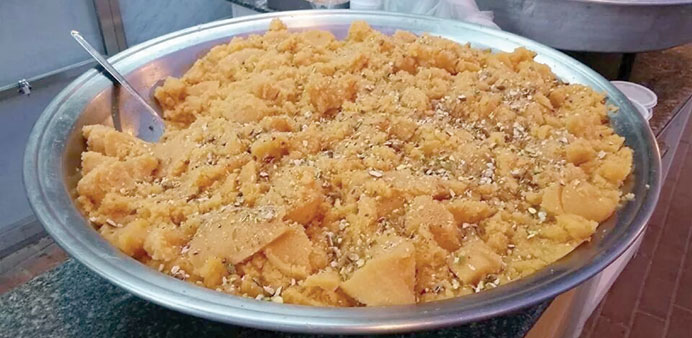
TRADITIONAL: Halwa is the most popular sweet dish for occasions like Eid.