


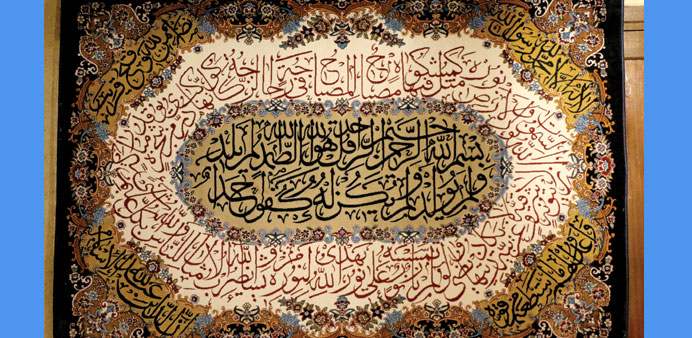
DELICATE: Silk carpets are often displayed on the wall like tapestries. Photo by Umer Nangiana
By Umer Nangiana
You see a finely woven, aesthetically patterned rug and the first thought that crosses your mind, most probably is: it must be Iranian. And it mostly turns out to be so. Persian carpets are that famous. They are simply irresistible once you lay your eyes on them.
The carpet traders at the Ramadan stalls in Katara Cultural Complex market do not even need to woo the customers. The rugs themselves do the job. Available in medium and smart sizes, the traders have a large collection of Persian rugs and carpets available at Katara market.
“Most of the rugs I have here are machine-made, although I have hand-made one at our store on Al Waab Street where we have a bigger shop. Here, I am selling ones that are fit for small drawing rooms and bedrooms and some for hanging on the walls,” Riazul Haq, a salesperson at one of the two stalls in the Katara market told Community.
Pointing to a bigger rug designed in lighter colours, he said that mostly people prefer to spread the bigger ones on the floors and then put the smaller ones over them for decoration. Most of his carpets, he added, are made of ordinary silk, however, some of the handmade are from pure silk.
A pure handmade smaller carpet of 2X3 would fetch Haq QR12,000, while an even finer one goes for QR25,000. They are mostly hanged on walls for decoration, Riaz said.
The Persian carpet or rugs are an essential part of Persian art and culture. Carpet-weaving is one of the most distinguished exhibitions of Persian culture and art, and dates back to ancient Persia. Iran produces about five million square metres of carpets annually, 80 percent of which are sold in international markets.
Riaz said his carpets also come directly from Iran, mostly from Isfahan. Iran is the world’s largest producer and exporter of handmade carpets, producing three quarters of the world’s total output. The carpet trader said the handmade carpets take longer time to complete, thus the higher prices.
Wool is the most common material for carpets but cotton is frequently used for the foundation of city and workshop carpets. There is a wide variety in types of wool used for weaving, such as Kork wool, Manchester wool, and in some cases even camel hair wool.
Silk carpets are less common than wool carpets since silk is more expensive and less durable; they tend to increase in value with age. Due to their rarity, value and lack of durability, silk carpets are often displayed on the wall like tapestries rather than being used as floor coverings.
Persian rugs are made up of a layout and a design, which in general includes one or a number of motifs. Some of these design and pattern groups are historic monuments and Islamic buildings, Shah Abbassi patterns, spiral patterns, all-over patterns, derivative patterns, interconnected patterns, paisley patterns, tree patterns, Turkoman patterns, hunting ground patterns, panel patterns, European flower patterns, vase patterns, intertwined fish patterns, Mehrab patterns, striped patterns, geometric patterns, tribal patterns, and composites.
Design can be described in terms of the manner in which it organises the field of the rug. One basic design may serve the entire field, or the surface may be covered by a pattern of repeating figures. In areas using long-established local designs, the weaver often works from memory, with the patterns passed on within the family.
For the more elaborate curvilinear designs, the patterns are carefully drawn to scale in the proper colours on graph paper. Each square thus becomes a knot, which allows for an accurate rendition of even the most complex design. “Today computers are used in the production of scale drawings for the weavers. First, they are designed on computers and then put on to the carpets,” said Riaz.
Persian rugs are typically designed using one of four patterns: all-over, central medallion, compartment and one-sided. Some of the more commonly used motifs in the design of Persian carpets are Boteh, Gul, Herati, Mina-Khani, Rosette, Shah Abbasi, Azari Kharchang, Islimi Floral and Mahi.