


By Julie Makinen
More than four years ago, just as China’s movie market was starting to boom, the producer behind blockbusters The Dark Knight, The Hangover and Man of Steel was casting about for a concept that might particularly suit Chinese audiences — and travel globally.
Thomas Tull’s fanboy imagination wandered to the Great Wall. What if, he wondered, the iconic edifice was built not to keep out hordes of Mongolians and other human invaders but to defend against fantastic monsters?
At the time, China’s annual box-office receipts were a mere $1.5 billion, a quarter of what they are today. Even with the market growing at a rapid clip, the notion of shooting a big-budget, English-language film set hundreds of years ago in mainland China — and based on an original American script with no built-in fan base — seemed like a fanciful business proposition.
But that is exactly what Tull’s Legendary Entertainment is now in the midst of doing.
Tull recruited China’s most famous director, Zhang Yimou, to helm the $150-million project and enlisted powerful investors including state-run China Film Group and LeVision Pictures. Matt Damon and Hong Kong legend Andy Lau are anchoring a cast peppered with Chinese heartthrobs who appeal to young Chinese women.
The Great Wall will soon move into postproduction with intensive visual-effects work in preparation for a November 2016 stateside release. It is one of the highest-budget films ever in China after months of shooting on 28 sets in Beijing and on an elaborate faux wall constructed in the eastern city of Qingdao, and will go down as the biggest US-China co-production to date.
If The Great Wall proves to be a global blockbuster, it could serve as a model of cross-Pacific collaboration for years to come — and position Legendary as a powerful player in what is soon to be the world’s largest movie market. But if it flops, it may be a dispiriting signal that the long-sought goal of bringing Hollywood and Chinese talents together is beyond the grasp of even one of the most astute operators in the industry.
Anticipation is running high in China. Zhang, Damon and Lau — along with other cast members including Pedro Pascal (Oberyn Martell on HBO’s Game of Thrones) and Chinese actress Jing Tian — this week sat for the first of what are sure to be numerous media events to stoke interest in the film.
Zhan Haicheng of China Film Group said the movie brought together the “best of China and US” and was a “real co-production.” He called it a “very American film.”
Whether Great Wall may be too American and fantastic for Chinese audiences, yet too Chinese for international viewers, remains a question on both sides of the Pacific.
Stan Rosen, a professor at USC and expert in Chinese movies, expects The Great Wall to perform strongly in China thanks to its brand-name Chinese stars and director and Hollywood-grade special effects. But he believes the tougher part may be attracting interest in the West, particularly during a crowded 2016 holiday movie season.
“I think they’re not so worried about the market in China; the big concern is the market in the US,” Rosen said.
Yet several people who work for Chinese entities involved in the production said they expect the movie to make much more money outside China. “It’s a very American story; this is an American film. I’m not sure Chinese can accept it,” said one, who asked not to be named so as not to damage business relationships.
Peter Loehr, chief executive of Legendary’s Asia arm, said producers “aren’t banking on this market or that market to take a disproportionate share” of ticket sales.
“If everyone else in the world does more (box office) than China, it’s great. If China does more, great, that’s even better,” he said. “The outlook from the beginning was (that) this is an international, English-language movie with Matt Damon and monsters, and it speaks to a specific demographic, and it happens to have Chinese themes.”
Though Hollywood studios have increasingly sought to release their blockbusters simultaneously in the US and China, such a day-and-date strategy may not be in the cards for The Great Wall. Legendary and its distribution partner, Universal Pictures, have already positioned the film to hit American theaters over Thanksgiving weekend next year.
But November is not a particularly popular moviegoing time in China. The film’s release date there has yet to be determined.
The film has been deemed an official US-China co-production by Chinese regulators, meaning it is not subject to import quotas and could secure a prime Chinese release date that would normally be off-limits to “foreign” movies.
Chinese authorities have been pushing overseas filmmakers to pursue such joint projects, in part to build up China’s film industry in a push to bring more “Chinese elements” into movies that might play globally.
But even if The Great Wall does prove to be a worldwide hit, Rosen says it doesn’t necessarily mean there are many other films that can follow in its footsteps.
“Great Wall is kind of a can’t-miss co-production in a way, but there aren’t that many other films that meet the standards for co-productions — with a largely Chinese cast, Chinese cultural elements and whatnot. There just aren’t that many that will have resonance in the Western market,” he said. “The Chinese government is promoting these things still, but I think for the money people, they’ll be much more selective on co-productions” in the future.
Many details of The Great Wall’s plot — to say nothing of the attributes of its mythical monsters — remain under wraps. But this much is clear: Damon will play William Garin, a mercenary from Europe who comes to China with Pero Tovar (Pascal), a swordsman with the flair of a bullfighter.
When “otherworldly creatures hellbent on devouring humanity” launch an attack, producers say, these journeymen partner with an army of Chinese warriors and “transform the Great Wall into a weapon” to defend humankind.
Actor Willem Dafoe plays a supporting role as Ballard, a shadowy foreign outsider who has been imprisoned in a Chinese fortress for years and plots to steal the Chinese army’s greatest weapon. Lau, known for his roles in films such as Infernal Affairs and House of Flying Daggers, portrays Strategist Wang, an alchemist, intellectual and technological innovator who must devise schemes and weaponry to defeat the assault.
The Chinese warriors include an all-female aerial division known as the Crane Corps and four other regiments named for animals including Bears, Deer and Eagles. Wang Junkai, lead singer of the Chinese boy band TF Boys, plays the teenage emperor whose kingdom is under assault.
The Great Wall went through several stages of development before cameras actually began to roll this spring. When Legendary first announced the project in 2011, Ed Zwick (The Last Samurai) was tapped as director, and the company was partnered
with Chinese studio
Huayi Bros.
Those plans fell by the wayside and Zhang Yimou came aboard in 2014. Known for his strong stylised visuals in films such as Hero and House of Flying Daggers, he also oversaw the lavish staging of the opening ceremonies of Beijing’s 2008 Summer Olympics. But he has never directed a movie with this degree of special effects, nor has he ever helmed a film in English.
But Zhang is being backed by a bevy of Hollywood heavy hitters: Industrial Light & Magic and Weta Workshop are doing visual-effects work on The Great Wall. Two-time Oscar winner John Myhre (Chicago, Memoirs of a Geisha) is the production designer, and Mayes Rubeo, who designed the costumes for Avatar, is also aboard.
“This is the biggest movie I’ve ever been involved with,” said Damon, who added that traveling to the real Great Wall was a highlight of his months in China. But when audiences see the film’s version of the wall, he added, they’ll be in for some “fun surprises.” —Los Angeles Times/TNS
*Nicole Liu in The Times’ Beijing bureau contributed
to this report.
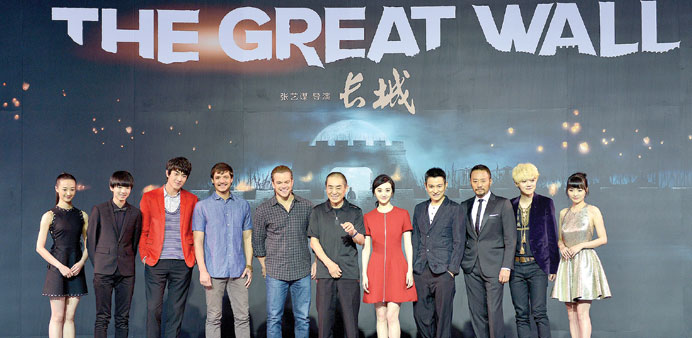
MAKING A STATEMENT: The cast of the The Great Wall pose in Beijing, China.