


DPA/Auckland
Rainbow Warrior was the name Greenpeace gave the ship it intended to carry out deployments against environmental destruction at sea at the end of the 1970s.
The name was inspired by the Cree people of North America, who prophesied: “When the world is sick and dying, the people will rise up like Warriors of the Rainbow.”
But the ship’s mission came to an abrupt end 30 years ago in Auckland Harbour, when French agents sank the vessel, drowning Fernando Pereira, a Portuguese-Dutch photographer working for the environmental organisation.
France’s DGSE intelligence service acted to stop the Rainbow Warrior embarking on a sea protest against the nuclear tests it was conducting on Moruroa Atoll in the Pacific.
“But it backfired,” the vessel’s skipper at the time, Pete Willcox, said.
“The act merely made the opponents of the nuclear testing more determined,” says Bunny McDiarmid, the current head of Greenpeace in New Zealand, and a former member of the ship’s crew.
Eighteen months after the sinking, the South Pacific Nuclear Free Zone Treaty came into effect.
In Auckland Harbour on July 10, 1985, a party was under way aboard the Rainbow Warrior ahead of the upcoming mission.
Just before midnight an explosion shook the ship. “I was asleep in my cabin,” Willcox says. The crew saw the water pouring in and abandoned ship, Pereira among them.
But the 35-year-old photographer decided to return to fetch his camera, when a second bomb tore a hole in the hull, sinking the Rainbow Warrior within minutes.
“I immediately thought there was something wrong, but we had no idea that the French government was so frightened of a bunch of young people that they wanted to murder us,” Willcox says.
Journalist David Robie had been on board for several weeks. His book, Eyes of Fire - the Last Voyage of the Rainbow Warrior, documents in detail the French involvement in the sinking.
“On that evening I actually wanted to take my sons aged nine and five and their scouting friends aboard. I cancelled at the last minute,” he says.
The “terrorist act,” as New Zealand politicians describe it, is without parallel between countries enjoying friendly relations.
The relationship between France and New Zealand suffered for years, but have since recovered.
“That lies far behind us in the past. Thank you for the call,” a spokeswoman for the French embassy said in a brief conversation by phone.
The New Zealand-France Friendship Fund was set up in 1991 using the $6.5mn paid in compensation by France. It promotes student exchanges and other relationship-building initatives.
A spokeswoman for the New Zealand foreign ministry says: “Our relations after 30 years are stronger than ever before.”
“We are using the anniversary to mark the brave actions of concerned citizens,” McDiarmid says.
Greenpeace France is organising a conference at the Eiffel Tower.
“The point at issue is that civil society all over the world is under fire,” says organiser Sylvain Trottier.
“It remains a puzzle to this day. Why did they do it?” Robie asks.
“It was totally counter-productive. Greenpeace received more support than ever before, and opposition to the testing grew.
“Other countries have learned nothing from it,” Willcox says. He was arrested with his crew in Russia in 2013 during a protest against oil-drilling in the Arctic, spending 100 days in detention.
“Millions of people heard for the first time about the devastating oil drilling as a result of the storm over our arrest,” he says.
Like the other members of the crew, Willcox, a US citizen, did not think for a minute of giving up following the trauma of Auckland.
“Acts like this will never silence us,” he says.
Now 62, Willcox is setting the new Rainbow Warrior on a course to protest against environmental pollution along Australia’s Great Barrier Reef to mark the anniversary.
He is not about to retire. “My father is 95. He is still sailing his dinghy to this day in races in New York,” he says with a laugh.
Two French agents involved were sentenced in New Zealand to 10 years in prison, but handed over to France shortly thereafter and released.
One of them, Alain Mafart, become a nature photographer and was almost published in a Greenpeace calendar in the United States, before he was identified at the last minute.
The wreck of the first Rainbow Warrior was towed out of Auckland Harbour and sunk at Matauri Bay in New Zealand’s Cavalli Islands. It is now a living reef, attracting marine life.
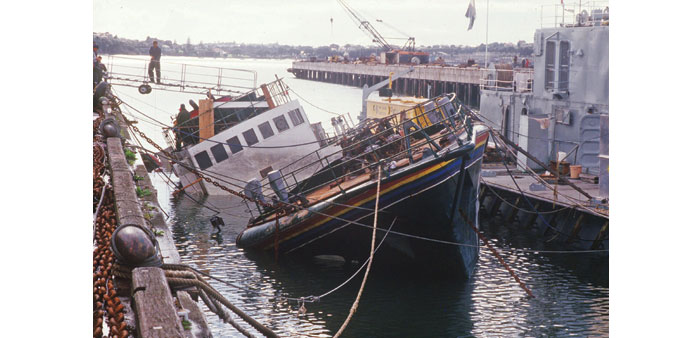
The Rainbow Warrior in New Zealand.