


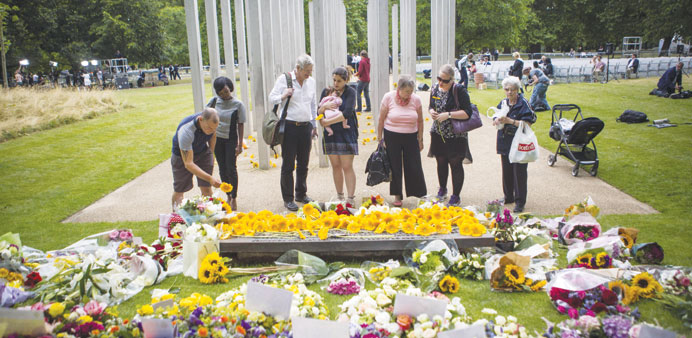
People place flowers at the 7/7 memorial in London’s Hyde Park on Tuesday, in memory of the 52 people killed during the London bombings of 2005.
By Updesh Kapur/Doha
Ten years ago this week, the foundations of British society were shaken to the core. It could never happen in Britain, said few. It was a matter of time, said many.
The 7th of July 2005 will forever remain etched in the fabric of British society.
It was a day after Britain celebrated winning the bid to host the 2012 London Olympics.
The nation was hit by something unimaginable.
Four suicide bombers had attacked central London’s transport system killing 52 innocent people and injuring hundreds more.
Three underground commuter trains and a red double-decker bus, iconic symbols of daily life in the capital, were targets of the terrorists during morning rush hour.
The aim was to kill, maim, cause maximum destruction, create an environment of fear and ultimately cripple London.
In detonating the bombs, they also marked a first – suicide attacks had come to Britain.
The nation had witnessed a new form of terror, fresh atrocities decades after bomb attacks on London by Irish dissidents.
Like its US peers in September 2001 when suicide bombers used commercial planes as ammunition to kill close to 3,000 innocent men, women and children in the worst ever terror attacks on American soil, Britain was facing a new threat.
Today, 10 years on from the 7/7 co-ordinated attacks in London, and 13 years on from the 9/11 US carnage, the threat from terrorism is more grave than ever before.
Sadly, the 7/7 and 9/11 suicide attacks are part of a grim catalogue of 21st century modern terrorism.
And suicide attacks are seen as the new wave of violent terror destined to cause mass devastation and bloodshed.
Yet amid the uncertainty of what will happen and when, it’s become more about awareness and attempting to lead a normal life as possible and not give in to those who inject fear and endanger lives.
Attacks of this nature are a test of character for the families of those who lost their lives and for the survivors who have to live through horrific injuries sustained and recounting the nightmare ordeal.
On Tuesday, the 10th anniversary of the London attacks, seeing images of families, victims and the emergency services from different backgrounds and communities stand side by side remembering those who died, demonstrated one thing.
A poignant reminder of that fateful day it was. But so too did it reflect the strength of those affected and how they pulled through in building their shattered lives.
Anniversaries will come and go – and each year, whether in London or the US – flowers will be laid and services and remembrance prayers held – but they mark resilience.
Watching George Psaradakis during the remembrance service at St Paul’s Cathedral as one of four people carrying candles representing the site of each blast, showed courage and respect.
He was the driver of the number 30 bus, whose roof was ripped off in the July 7 explosion killing 13 of his passengers.
A minute’s silence to mark the moment the first bomb went off 10 years ago was observed impeccably at the four sites. There was a minute’s silence nationally hours later with many bus and underground train services in the capital coming to a halt for 60 seconds. Commuters and tourists sat and stood still, then went about their normal business. It could have been any one of them in 2005.
Commuters across Britain were encouraged to get off public transport earlier than usual on Tuesday and walk the last leg of their journey in a show of solidarity. It echoed that fateful day when London’s transport system was thrown into chaos forcing passengers to walk.
The blasts hit a city where millions travel daily by bus and train. The ones who died were part of the London transport family just going about their daily routines heading to work or seeing the sights of the capital.
Sounds cliché but London never stood still after 7/7. Yes, security measures were stepped up because the city was facing terror threats like never before. Yet it needed to be resilient and not succumb to fear.
London did a fine job in hosting the Olympics three years ago. Amid the biggest security operation ever seen in the British gateway, London was determined to do its best – and that it did.
Stories of courage that have emerged of those who wanted to put the scars behind them and get on with life are both heartening and inspirational.
The lady who lost both her legs in one of the train blasts became a motivational speaker and Paralympian who competed in the 2012 London Games.
Another who lost limbs resorted to charity work in the community where one of the London suicide bombers was raised.
Some turned to setting up charitable foundations in memory of loved ones and renounce hatred, bitterness and anger.
Many relatives and survivors have supported each other by becoming friends having been strangers until their lives were brought together by the bombings.
In essence, tolerance and unity help fight evils and overcome negativity, but most of all the spirit of the people is what ultimately wins.
At a time when the world reflects on the deadly Tunisia beach terror attacks in which most of the 38 people who died were British, resilience and spirit will forever be needed to overcome tragedy.
As one of those who helped the injured on 7/7 recalled during Tuesday’s memorial service, terrorism has the power to destroy individual lives, but it will never win.
“They won’t beat us because there’s simply no point at which we will ever surrender to terrorism,” he said. “That’s not the spirit we saw on July 7, that’s not the spirit we’ve ever seen, that’s not the spirit we will ever see.”
♦ Updesh Kapur is a PR & communications professional, columnist, aviation, hospitality and travel analyst. He can be followed on twitter @updeshkapur