


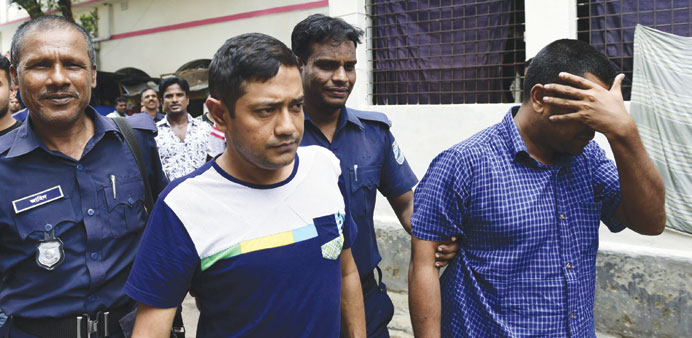
Owner of the collapsed Rana Plaza building Sohel Rana, second left, is escorted by security personnel ahead of his appearance at a court in Dhaka yesterday.
AFP
Dhaka
A Bangladesh court yesterday ordered the government to allow the prosecution of four inspectors for mass murder over the 2013 Rana Plaza factory disaster to go ahead after ministries tried to stall their cases.
Police filed charges last month against 41 people over the collapse of the garment factory complex in April 2013 when more than 1,100 people were crushed to death in a suburb of the capital Dhaka.
Among those facing murder charges are three factory inspectors who work for the labour ministry and a building inspector employed by the local
government ministry.
But under Bangladeshi law, their cases cannot proceed without the express approval by the relevant government ministry or agency which has so far been withheld in all four cases.
But yesterday senior judicial magistrate Shahinur Rahman ordered the two ministries to drop their objections, according to prosecution and defence lawyers.
Rahman had issued a notice “ordering the two government ministries to sanction the case against the four,” said prosecution lawyer Anwarul Kabir.
“Once the ministries give the approval, there will be no bar
to prosecute them,” Kabir said.
Defence lawyer Masum Iqbal Raj, who represents the owner of the building and three other accused, said the ministries are expected to give their approval by August 18, the next date of pre-trial hearing.
“The ministries should abide by the court order,” he said.
Prosecutors have accused the four of gross negligence by allowing the building, which was meant to be a market, to be transformed into a factory complex laden with heavy machinery which triggered the collapse.
The three labour inspectors are also accused of illegally helping the owner secure factory
licences.
Bangladeshi media have criticised attempts to stall the prosecution of the inspectors, saying the move raised questions over the government’s sincerity in bringing justice to the victims of the tragedy.
The Rana Plaza collapse was the worst of a series of deadly disasters to blight Bangladesh’s $25bn garment industry, the world’s second largest after
China.
A host of Western retailers had clothing made at Rana Plaza, including Italy’s Benetton, Spain’s Mango and the British low-cost chain Primark.
The disaster prompted sweeping reforms including new safety inspections and higher wages in the industry, which employs around four million workers.