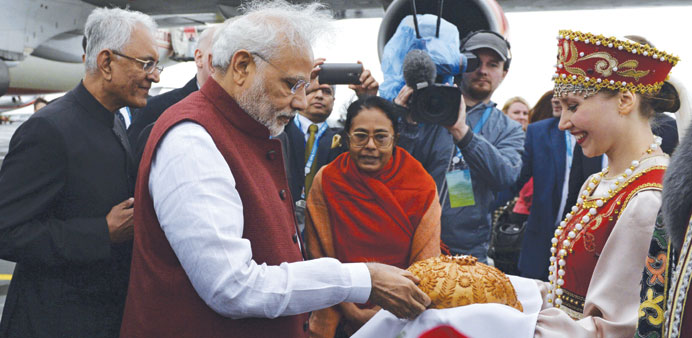
Prime Minister Narendra Modi takes part in a traditional bread and salt ceremony upon his arrival before attending the Brics and the Shanghai Co-operation Organisation (SCO) summits in Ufa, Russia yesterday.
Agencies/Moscow
India is set to become a full-fledged member of the Shanghai Co-operation Organisation (SCO), a Eurasian political and military alliance that includes China and most of Central Asia, Russian President Vladimir Putin said yesterday.
“We are beginning the process for India’s complete ascension to the SCO,” Putin said during a meeting with Prime Minister Narendra Modi at a combined summit of the SCO and BRICS emerging economies in the Russian city of Ufa.
Putin said it was “a very important event,” as Modi expressed his thanks.
“Under your (Putin’s) leadership in BRICS, India has become a member of SCO. I am very grateful,” the prime minister said.
India currently has observer status in the SCO, and is one of the five members of the Brics: Brazil, Russia, India, China and South Africa.
As the two groups are challenges to Western hegemony, the combined summits have given Putin an opportunity to reassert Moscow’s presence on the world stage in the face of floundering ties with the West because of its role in the Ukraine crisis.
Both events are set to continue through Saturday.
Modi thanked Putin for the warm welcome and also for observance of the International Day of Yoga in Russian cities on June 21.
Putin said jocularly that he has not tried to do yoga yet, though he is all for it.
Modi arrived in Russia from Kazakhstan.
Earlier in the day, Kazakhstan signed an agreement with India to supply New Delhi with 5,000 tonnes of uranium over the next five years.
“The signing of a contract to supply India with 5,000 tonnes of uranium from 2015 to 2019 is testimony of the systematic development of co-operation in the energy sphere,” , Kazakh President Nursultan Nazarbayev said after meeting Modi.
Kazakhstan is the world’s leading uranium producer.
“We greatly value our relationship with Kazakhstan,” said Modi, adding it was “one of the first countries with which we launched civil nuclear co-operation.”
Kazakhstan supplied India with 2,100 tonnes of uranium between 2010 and 2014.
“We are pleased to have a much larger second contract now,” Modi said, calling Kazakhstan “our biggest economic partner in the region.”
The two countries also signed agreements on defence and railways.
“Kazakhstan is our biggest economic partner in the region. We will work together to take economic ties to a new level,” Modi said.
“We both agree that connectivity is an important issue, but one that we will address,” he said, according to tweets by external affairs ministry spokesman Vikas Swarup.
Modi also thanked Kazakhstan for its “continued support” for India’s candidature for a permanent seat in the UN Security Council.
The Indian prime minister arrived in Kazakhstan on Tuesday as part of a tour of the five ex-Soviet Central Asian countries. He has already visited Uzbekistan and is set to visit Kyrgyzstan, Turkmenistan and Tajikistan.
He hailed “a new era in our relationship with Central Asia” at a speech at a university in Kazakhstan on Tuesday.