


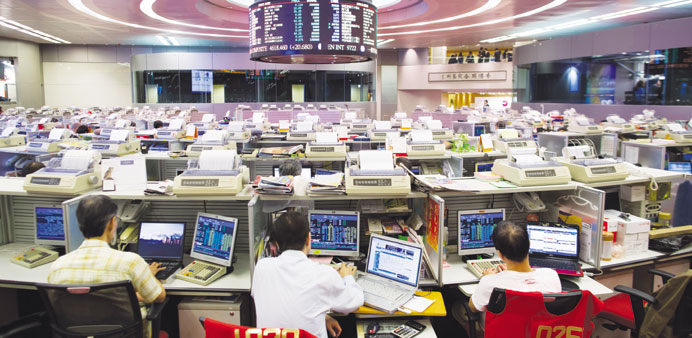
Traders work at the Hong Kong Stock Exchange. Shares ended down 218.21 points to 26,064.11 yesterday.
AFP/Tokyo
Asian markets mostly retreated yesterday ahead of the weekend’s Greek referendum that could decide its eurozone future, while Shanghai plunged almost 6%, at the end of another torrid week for mainland investors.
Wall Street ended in the red as a strong increase in US jobs was overshadowed by the Greek crisis and stagnant wage growth.
Seoul dropped 0.14%, or 2.92 points, to end at 2,104.41 and Sydney fell 61.5 points, or 1.1%, to 5,538.3. Hong Kong fell 0.83%, or 218.21 points, to 26,064.11.
Shanghai tumbled 7.13% at one point in the morning and Shenzhen slumped 6.96%, with mainland markets pummelled by profit-taking and margin traders calling in their bets.
Despite a mild recovery in early afternoon exchanges the two indexes closed sharply lower again. Shanghai slid 5.77%, or 225.85 points, to 3,686.92, giving up 12.07% since last Friday.
Shenzhen sank 5.30%, or 117.33 points, to 2,098.48 - losing 16.16% over the week.
However, Tokyo reversed morning losses to end marginally higher, adding 17.29 points to 20,539.79.
In other markets, Bangkok dropped 0.14%, or 2.03 points, to 1,489.59; oil company PTT fell 0.56% to 354baht, while Bumrungrad Hospital fell 1.33% to 186baht.
Jakarta ended up 0.77%, or 38.13 points, to 4.982.91; Indonesia-based oil palm business PT Perusahaan Perkebunan London Sumatra Indonesia Tbk gained 4.73% to 1,660 rupiah, while cement company PT Semen Indonesia Tbk slipped 0.81% to 12,250 rupiah.
Malaysia’s key index gained 0.36 points or 0.02% to 1,734.24; Maybank fell 0.11% to 9.28 ringgit, Telekom Malaysia added 0.29% to 6.85 while Genting Malaysia went up 0.95% to 4.24 ringgit.
Singapore’s Straits Times Index closed 0.45% or 14.89 points higher at 3,342.73; Banking group DBS closed 2.0% or 41 cents higher at Sg$20.91, while SingTel closed unchanged at Sg$4.25.
Taipei slipped 0.22%, or 21.01 points, to 9,358.23.
Wellington edged down 0.01%, or 0.58 points, to 5,840.89; Air New Zealand slipped 0.77% to NZ$2.57 and Fletcher Building was off 1.10% at NZ$8.07.
Manila closed 0.57%, or 43.01 points, lower at 7,535.30; Philippine Long Distance Telephone was unchanged at 2,800 pesos, Ayala Land fell 2.26% to 36.80 pesos and Universal Robina was down 0.05% at 193.80 pesos.
With Greeks heading to the polls Sunday, analysts said investors were in a holding pattern until they had a better idea about the country’s future.
Greek Prime Minister Alexis Tsipras broke off debt reform talks today and called the plebiscite on creditors’ proposals—leading it to default on a loan repayment Tuesday.
European leaders have warned that the poll is effectively an in-out vote on Greece’s future in the eurozone.
“There could be some hesitation from investors” ahead of the Greek vote, Chris Weston, chief market strategist at IG in Melbourne, said.
“Markets just want to see it getting solved so the contagion effect can be mitigated and we can move on to other things.”
The EU and IMF added to pressure Thursday, slashing Greece’s growth forecasts for this year and warning it will need tens of billions of euros over the next three years to stabilise its finances.
US data showed the economy created a solid 223,000 jobs in June and the unemployment rate fell to 5.3% from 5.5%. However, the report also said hourly earnings were flat compared with May, while the estimates for job growth in April and May were cut.
The Dow dipped 0.18%, the S&P 500 eased 0.06% and the Nasdaq dropped 0.10%.
The soft wage data led investors to ease back on their bets for a September Federal Reserve interest rate rise, with speculation now for a December lift-off.
That pushed the dollar lower, buying ¥123.05 in Asia, against ¥123.07 in New York and well off the ¥123.54 earlier Thursday in Tokyo.
The euro fetched $1.1102 and ¥136.70 against $1.1086 and ¥136.43.
Mainland Chinese markets resumed their sharp downward spiral, with Shanghai now down almost a third from its June 12 peak.
It had risen more than 150% over the previous year but economists say it has been hit by fears stocks were overvalued, profit-taking and margin traders unwinding their positions.
Interventions by authorities including a surprise interest rate cut at the weekend—the fourth since November—and relaxing rules on margin trading have failed to arrest the declines.
“For now, the mood is verging on panic, and it is extremely hard to calm a bear who is in a rage,” Bernard Aw, a strategist at IG Asia in Singapore, said.
And Cinda Securities chief strategist Chen Jiahe told AFP: “China has too many retail investors and their state of mind is very unstable and they lack professional investment knowledge.”
The country’s market regulator pledged Thursday to crack down on market manipulation after rumours that foreign short-sellers were behind recent losses.