


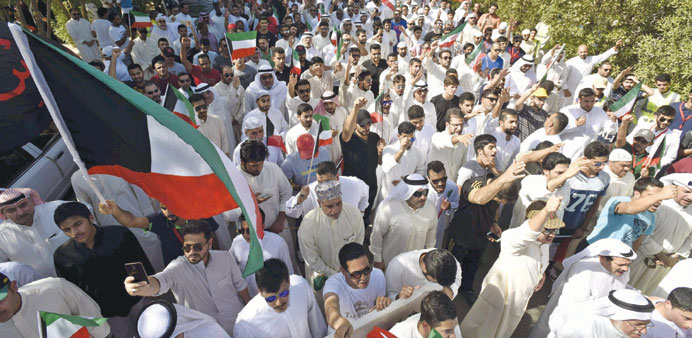
Mourners during the funeral of the victim’s of Friday’s bombing at al Jafariya cemetery, in Suleibikhat, Kuwait, yesterday.
Reuters
Kuwait City
Kuwait detained the owner of a car that took a bomber to a mosque to carry out the country’s worst-ever militant attack, officials said yesterday, as thousands calling for national unity turned out to bury some of the 27 killed.
Militant group Islamic State claimed responsibility for the suicide bombing against 2,000 worshippers praying at the Imam al-Sadiq mosque on Friday, one of three attacks on three continents that day apparently linked to hardline groups.
In Tunisia, a gunman killed 37 people, including Western tourists, on a beach, and in France a decapitated body was found after an attacker rammed his car into a gas container, triggering an explosion.
Officials said the bombing was clearly meant to stir enmity between majority Sunnis and minority Shias and harm the harmonious ties between the sects in Kuwait.
In a statement, the information ministry said Kuwait would face the situation with “unity and solidarity”. It reiterated what it called the government’s strong stance on the freedom of religion and opinion, noting these were rights protected by the constitution.
The interior ministry, which reported the vehicle owner’s arrest, said it was now looking for the driver who vanished shortly after Friday’s blast in Kuwait.
A security source told Reuters “numerous arrests” had been made in connection with Friday’s bombing.
At the burial site in the Sulaibikhat district, some waved Kuwaiti flags while others bore the large mourning banners, in red, black or green, that are typical of Shia funerals.
Chants from the crowd included “Brothers of Sunni and Shia, we will not sell out our country”, “No Sunni, no Shia, we are one Islam”, “The martyrs are the beloved of God” and “Down with Daesh! Down with Daesh”, an acronym for Islamic State.
One group of mourners said they had travelled from Qatif in Saudi Arabia where 21 people were killed by an Islamic State suicide bombing in May.
Two Iranian nationals were among those killed, foreign ministry spokeswoman Marzieh Afkham was quoted as saying by Iranian state media yesterday.
Relatives of seven of those killed wept and prayed over their shrouded corpses at a mosque yesterday, where they were waiting to be taken to the Shia cities of Najaf and Karbala in Iraq for burial.
Shias are between 15 and 30% of the population of Kuwait, a mostly Sunni country where members of both communities live side by side in
amity.
“We will cut the evil hand that interferes with our homeland’s security,” Interior Minister Sheikh Mohamed al-Khaled al-Sabah was quoted as saying by state news agency Kuna.
Kuwait has stepped up security to the highest level at state-run oil conglomerate Kuwait Petroleum Corp (KPC) and its affiliates, Kuna also reported.
Islamic State named the bomber as Abu Suleiman al-Muwahed.
Islamic State had urged its followers on Tuesday to step up attacks during the Ramadan fasting month against Christians, Shias and Sunni Muslims fighting with a US-led coalition against the hardline group.
There was no evidence Friday’s three attacks were deliberately co-ordinated. But coming so close together, they underscored the far-reaching, fast-growing influence of Islamic State, Western politicians said.