


DPA/Washington
The US Supreme Court delivered a major victory for President Barack Obama’s healthcare reforms yesterday with a decision that upholds the subsidies at the heart of the insurance reforms.
The court ruled 6-3 that language in the healthcare law was meant to allow consumers in all 50 US states to purchase health insurance with federal government subsidies.
Opponents had argued that wording in the law meant the states – and not the national government – had to fund the subsidies.
Celebrating the ruling, Obama declared that the healthcare reforms – his signature domestic policy – are “here to stay”.
“Today is a victory for hard-working Americans all across this country whose lives have become more secure because of this law,” he said in remarks in the White House Rose Garden.
He pointed to millions of Americans who can now afford health insurance for the first time and who would have lost their coverage if the court had ruled against the government.
“America would have gone backward,” he said.
Earlier, outside the Supreme Court, chants of “Don’t you dare take my care” turned into chants of “ACA is here to stay” when the decision came out.
Most outside the court had been awaiting another expected decision on gay marriage, but a few dozen cheered in excitement about the Affordable Care Act decision.
“It’s a good day for healthcare in America,” said Benton Strong, of the left-leaning activist group the Centre for American Progress Action Fund.
The case, King v Burwell, revolved around tax subsidies provided to consumers to buy health insurance and whether millions of Americans are entitled to receive the benefits under the law.
If the court had ruled that the subsidies were not legal, some 7.5mn people could have lost the benefits, making the insurance unaffordable and undermining the viability of the entire health insurance programme.
The law made provisions for the 50 states to set up online marketplaces for individuals to purchase health insurance.
However, many states led by centre-right Republican governors refused to do so in protest of the legislation, meaning citizens in those states instead had to buy insurance through a federal system.
At issue before the Supreme Court was a phrase in the legislation setting out subsidies for those who purchase insurance on healthcare exchanges “established by the state”.
Opponents of the law argued that, because of those four words, people who bought insurance through the federal system were not eligible to receive the subsidies put in place to make insurance affordable, because the organisational framework for those exchanges was supposed to have been put in place at the state level.
The majority of the court’s nine justices disagreed.
Chief Justice John Roberts noted in his opinion that, if people who bought insurance on the federal exchange were ineligible for the subsidies, that it would undermine Congress’ entire intent in crafting the legislation and would create a vicious circle in which health insurance became more and more expensive as fewer and fewer people opt to purchase it.
The opponents’ argument “would destabilise the individual insurance market in any state with a federal exchange, and likely create the very ‘death spirals’ that Congress designed the Act to avoid”, he wrote.
The subsidies, in the form of tax credits, are crucial to the operation of the healthcare scheme because some 87% of people who bought insurance through the system use the subsidies.
Without them, insurance plans would be too expensive for government officials to require their purchase.
The healthcare reform has remained a flashpoint of US politics since it passed Congress in 2010, but the Supreme Court upheld the overall law in 2012.
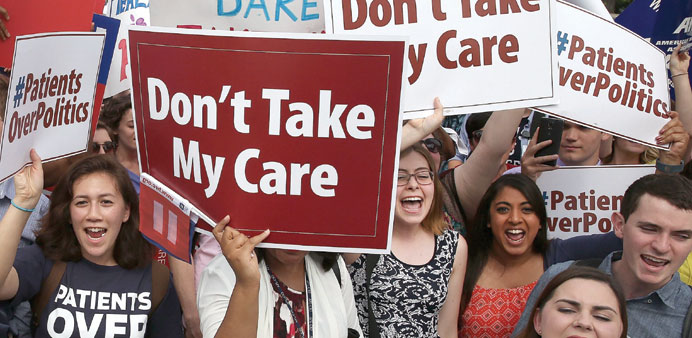
People celebrate in front of the US Supreme Court after the ruling was announced on the Affordable Care Act yesterday in Washington, DC.