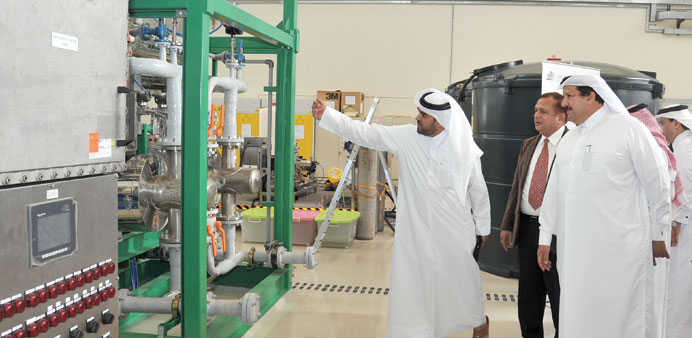
Dr al-Marri and al-Sowaidi among other senior QU and Qafco officials during the launch of the Heat Exchanger Pilot Plant at the Gas Processing Centre (GPC) of the College of Engineering (CENG).
Qatar University (QU) in co-operation with Qatar Fertiliser Company (Qafco) launched the Heat Exchanger Pilot Plant at the Gas Processing Centre (GPC) of the College of Engineering (CENG).
The plant has been set up to study seawater behaviour in heat exchanger applications.
It is part of an agreement signed between the two organisations in 2012 to enhance co-operation in areas related to energy systems and to develop teaching, academic research and training opportunities at the GPC and CENG.
The agreement also included the establishment of a Qafco Chair in Energy Systems at CENG to develop an applied research programme in the area of energy systems according to Qafco needs.
Among those who attended the event were GPC director, Dr Mohamed Jaber al-Marri, Qafco vice-chairman and CEO, Khalifa al-Sowaidi and several QU, CENG and Qafco officials.
Dr al-Marri thanked Qafco for building and commissioning the pilot plant and appointing a Qafco Chair in energy systems.
He said: “Such partnerships enhance the process of connecting research with education towards achieving the objectives and priorities of Qatar. The significance of the pilot plant is the opportunity it provides to open the centre to new horizons and extensive scientific research in corrosion and energy efficiency.”
Al-Sowaidi said, “Qafco is committed to the further development of Qatar and views itself as a partner in contributing to the transfer of knowledge between university and industry. This, we intend to achieve through participation with universities and research institutes in Qatar.
“The commissioning of the plant is a part of the series of initiatives that are planned between Qatar University and Qafco. It will study seawater behaviour in heat exchanger applications. The research work will benefit Qafco and other industries to study sea water-related problems of metallurgy on a pilot scale. It will benefit the university engineering students to understand industrial applications, and to study and develop solutions to industry-related problems.”