


AFP/Paris
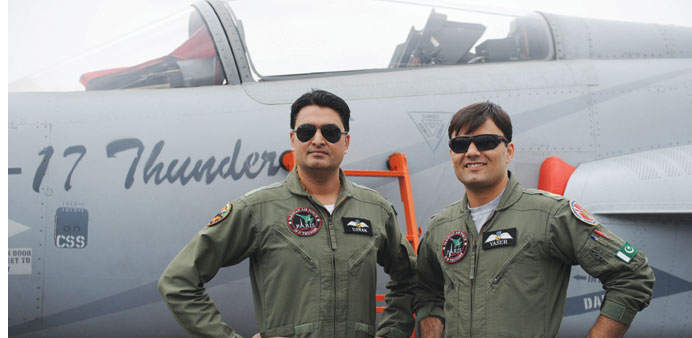
Pakistan has won the first order for its JF-17 Thunder jet fighters, an air force spokesman said yesterday, a long-held goal for the nation which wants to boost its military exports.
The latest models of the jets, which are locally produced in co-operation with Pakistan’s close ally China, are lightweight multi-role aircraft capable of Mach 2.0 (twice the speed of sound) with an operational ceiling of 55,000 feet.
Speaking to AFP from the Paris Air Show by phone, Air Commodore Syed Mohamed Ali said an order for the plane had been finalised but declined to give details.
“That’s the case, we’ve finalised the order,” he said, citing sensitivities for not naming the client, the number of aircraft or the date of delivery.
A report on the aviation website Flightglobal.com quoted another senior officer, Air Commodore Khalid Mahmood, as saying the sale had been made to an “Asian country” and the delivery would take place in 2017.
The report added that 80 people were promoting the JF-17 in Paris this year, reflecting a significant marketing push.
Pakistan’s large and well-funded military has long been a major importer of defence equipment, particularly from China.
But Pakistan is hoping the updated JF-17, along with Pakistani-made tanks and surveillance drones, will help increase military exports and bring in much-needed foreign exchange.
Analysts believe the major selling point of the JF-17 is its cost, which is likely to be substantially less than the $16-18mn cost of an US-made F-16.
Pakistan Air Force has brought three examples this year at the air show. One will appear on the static display, one will appear in the flying display, and the third will serve as a backup.
The JF-17 contingent at Paris this year is 80 strong, representing a significant marketing push. Khalid says the show is a good venue for meeting prospective customers from French speaking countries.
He says 11 countries are looking at the type, which mirrors previous comments made by Chinese defence export agency Catic, which also markets the aircraft, and Pakistan Air Force officials.
Khalid also provided an update of Pakistan’s induction of the type. So far, 54 examples have been delivered. The first 50 were originally delivered in a Block I configuration, and these are in the process of being updated to a Block II standard.
The Block II configuration features improved avionics and better software, and adds a fixed air-to-air refuelling probe.
An additional 46 aircraft will be delivered in the Block II configuration.
A subsequent 50 aircraft, which will push Pakistan’s fleet to 150 examples, will have a Block III configuration. These will all be delivered by the end of 2018.
The aircraft’s developers are still working out the specifications of the Block III aircraft, but upgrades could include an active electronically scanned array (AESA) or passive electronically scanned array (PESA) radar, says Khalid.