Reuters/Hong Kong
China will likely quicken reforms to encourage more foreign investment in its markets after a decision by US index provider MSCI Inc to hold off on including China’s domestic shares in its emerging market index.
The long-awaited decision by MSCI, whose indexes are tracked by funds managing trillions of dollars, disappointed many market players, especially after its rival FTSE Russell launched two transitional indexes that include A-shares two weeks ago.
Despite a recent acceleration of Beijing’s reform agenda, MSCI said global investors wanted China to go further in removing barriers that make it difficult for foreigners to invest in the country.
MSCI said its delay in accepting A-shares was mainly due to China’s quota allocation process, capital mobility restrictions and beneficial ownership of investments, issues which Beijing has been working on over the past year.
One of the key obstacles is that international investors cannot access Shenzhen-listed stocks which represent 41% of total A-share market capitalisation, said Goldman Sachs analysts in a note.
“Our expectation is that the Shenzhen-Hong Kong connect scheme could be unveiled in the near future and could be up and running in the 4Q15(it) could open a special review by the MSCI,” the analysts said. Other possible reforms could include a stock link between Shanghai and Taiwan as well as a bond connector that allows more foreign investors to enter the world’s third-biggest debt market.
MSCI said the decision on including A-shares will remain on the 2016 review list and it may fall outside of its regular schedule of classification reviews.
However, even as Beijing is accelerating the pace to open up its domestic market, foreign investors remain cautious when buying yuan assets due to a lack of knowledge of the market and regulatory issues.
Many global funds still have no or negligible exposure to yuan assets, though the “redback” has become the fifth most-used currency globally and China is the world’s second-largest economy.
As an example, Canadian Pension Plan Investment Board has only 1% of its portfolio allocated in yuan assets now, according to Shanghai-based fund consultancy Z-Ben Advisors.
A-shares will eventually be included in global indexes, and what remains to be seen is whether or not the global investment community will finally begin acknowledging the fact that China and the yuan, as an asset class, must be taken into consideration, said Z-Ben Advisors.
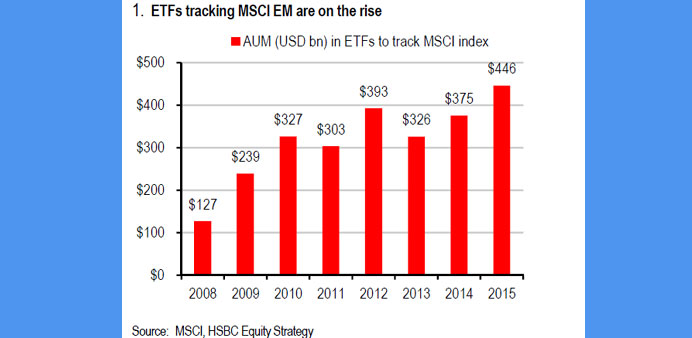
The combined assets under management (AUM) that track the MSCI emerging market index reached $1.7tn as of mid-2014, and AUM for Exchange Traded Funds (ETFs) tracked by the MSCI family has amounted to $450bn this year, HSBC statistics showed.