


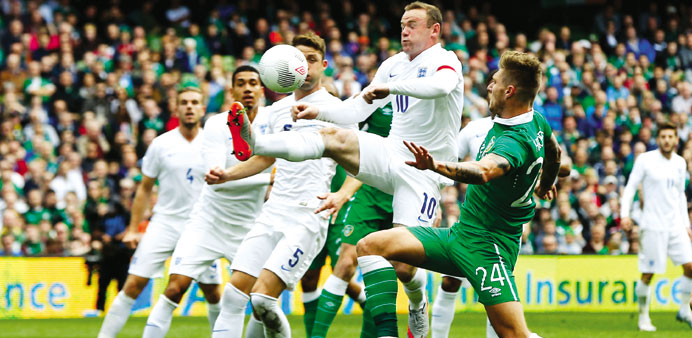
England’s Wayne Rooney (No 10) vying for the ball with Ireland’s Jeff Hendrick (R). (Reuters)
AFP/Dublin
England’s winless run against neighbours the Republic of Ireland was extended to six matches yesterday following a torpid 0-0 draw in a friendly game at Dublin’s Aviva Stadium.
It was the first time England had played in Dublin since rioting far-right hooligans caused a friendly in February 1995 to be abandoned after only 27 minutes, but while the reunion thankfully passed off without incident off the pitch, there was precious little to stir the blood on it.
In the end, the game was chiefly notable for its debutants—Jamie Vardy for England, Harry Arter for Ireland—but visiting manager Roy Hodgson admitted it had been “way below” what his team had hoped to achieve.
“All credit to Ireland, they caused us problems, particularly with balls to the front players,” he said.
“I think we needed this game and this level of competition. Going into the game against Slovenia, there’s a lot of things we want to improve on.”
Both teams will now switch their attentions to 2016 European Championship qualifiers next weekend, when Ireland host Scotland in a key Group D fixture and England look to extend their 100 percent record in Group E away to Slovenia.
“It was exactly what we needed,” said Ireland manager Martin O’Neill.
“Overall it was good for us and from a physical viewpoint, it couldn’t have been better timed.”
The Football Association had written to England’s 3,000 travelling fans warning them not to repeat chants about Irish paramilitary group the IRA that had been aired during recent away games against Scotland and Italy.
But it was with wit, rather than viciousness, that England’s fans goaded their hosts, chanting “Sepp Blatter, he paid for your ground!” in reference to this week’s revelation that FIFA paid the Football Association of Ireland five million euros ($5.5 million) after Thierry Henry’s handball took France to the
2010 World Cup at Ireland’s expense.
Rooney miscues
A small number of home fans whistled during ‘God Save the Queen’, but it was Liverpool contract rebel Raheem Sterling, English football’s new Public Enemy Number One, who bore the brunt of their ire.
Generally, though, the atmosphere was as flat as a pancake, even after a moving pre-match moment when Jack Charlton—the former England defender and Ireland manager—was given a standing ovation by the whole ground.
England’s probings, generally instigated by midfield anchor Jack Wilshere, came to nought, and it was Ireland who created what few chances there were in the first half.
Daryl Murphy jabbed fractionally wide from Jeff Hendrick’s flick-on, while David McGoldrick, Murphy’s Ipswich Town teammate, saw a shot deflected behind by Gary Cahill.
It was not until a minute before half-time that England mustered an attempt at goal, Adam Lallana cutting in from the left and shooting over.
England captain Wayne Rooney was a virtual bystander in the first half and when Jordan Henderson’s pass gave him a clear run on goal early in the second, his touch betrayed him.
The game began to open up a bit though, with England goalkeeper Joe Hart ferrying a Robbie Brady free-kick around his near post and parrying from substitute Jon Walters at one end, and Sterling shooting wide at the other.
A gaggle of Irish substitutions early in the second half included a debut for Bournemouth midfielder Arter, who replaced Glenn Whelan.
Leicester City striker Vardy entered the fray with 16 minutes to play, replacing Rooney, to complete a remarkable three-year ascent from non-league to international football.
After Arter had drilled wide following a run from deep, England substitute Andros Townsend took aim from distance, but Ireland goalkeeper Shay Given, who had replaced Keiren Westwood, got down well to keep the visitors without a win in Ireland since a 3-1 friendly success in May 1964.