By Andy Home /London
Stocks of tin held in London Metal Exchange (LME) warehouses currently stand at 7,570 tonnes.
It’s the lowest level since late 2008 but you’d be forgiven for not noticing.
The London tin market seems blissfully unconcerned by the steady decline in exchange-registered inventory.
Tin is by some margin the worst performer of the LME base metals so far this year. Three-month metal is down by just over 20% since the start of January and is currently trading languidly around the $15,500-per tonne level.
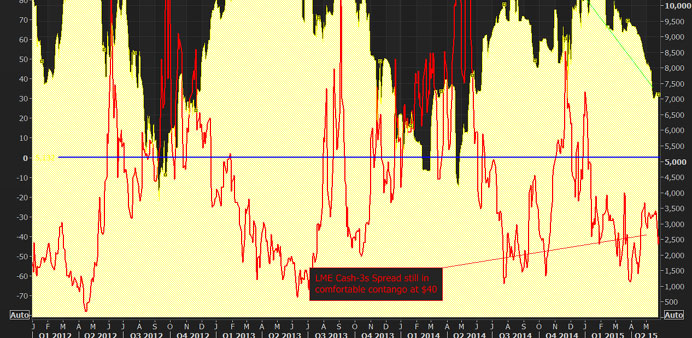
Nor is there any sign of tension in the front part of the forward curve. The benchmark cash-to-three-months period ended Thursday valued at a comfortable $40 per tonne contango.
The general consensus is that tin is currently in oversupply, thanks first and foremost to the emergence of Myanmar as a new global supplier.
Moreover, Indonesian exports have risen this year despite local producers’ stated aim of supporting the price by limiting overseas shipments.
Hence the distinct lack of panic in the London market.
But it may be at risk of complacency, ignoring potentially far-reaching changes in the structure of the global market-place for the soldering metal.
There is a sense that tin is the victim of its own previous narrative of structural supply deficit.
That narrative was predicated on a combination of declining output at existing producers, a lack of new mines and the vagaries of exports from Indonesia, the largest single supplier of metal to the international market.
Myanmar, however, has blown that narrative out of the water.
The country has turned out to be a major new source of mined supply, pumping low-grade material into China and reducing that country’s import needs.
China’s imports of refined tin have plummeted over the last couple of years from almost 30,000 tonnes in 2012 to just 7,800 tonnes in 2014.
Imports of tin ore from Myanmar, on the other hand, have mushroomed over the same period and they are still rising. The tally in the first four months of this year was 89,000 tonnes, almost double the level in the same period of last year.
Thanks to Myanmar, China’s own production of refined tin surged by 22% to 187,000 tonnes last year.
That in turn has diminished the influence of Indonesia in the global supply picture.
The latest threats by Indonesian producers to limit exports and by the Indonesian government to tighten export rules still further have simply not resonated with the market in the way they once did in the past.
The fact that exports are still running above the threatened 4,500-tonnes per month cap apparently agreed by local smelters doesn’t of course help the Indonesian cause.
Exports did slow sharply in April to just over 5,000 tonnes but at a cumulative 24,800 tonnes so far this year they are still running 14% above 2014 levels.
Particularly when the amount of cancelled tonnage, meaning metal earmarked for physical drawdown from the system, is at a relatively low 610 tonnes, or just 8.1% of the total? Tin spreads have a habit of catching short position-holders by surprise, with the LME contract’s relatively low liquidity causing violent and sudden flare-outs.
The money managers holding short positions equivalent to 16.7% of tin open interest as of the close of last week are evidently unconcerned.
After all, this is a market in oversupply right? Yet the key question is the location of that oversupply. Because if it’s in China, which is a logical inference given the stream of tin flowing from Myanmar, there’s a new element in the global supply equation.
It’s called the Shanghai Futures Exchange (SHFE), which launched a tin futures contract at the end of March.
It’s noticeable that while LME stocks of tin have been dwindling, those registered with the SHFE have been trending higher. They rose another 300 tonnes this week and currently stand at 1,055 tonnes.
The advent of tin trading in Shanghai may represent a step-change in how global tin is traded and how much tin is available for delivery to the LME.
Right now there are only four domestic brands that are deliverable against the SHFE contract, namely Yunnan Tin, China Tin, Yunnan Chengfeng and Gejiu Kaimen.
More local and foreign brands will follow, according to industry association ITRI, which has just held a tin forum in the city.
Also present at the forum were representatives of Indonesia’s Commodity and Derivatives Exchange (ICDX), through which Indonesian tin must trade before it can be exported.
** Andy Home is a columnist for Reuters. The opinions expressed here are his own.