


Emergency responders are still dealing with the fallout of Nepal’s two devastating earthquakes and using advanced technology and platforms, some of which have been developed by Qatar Computing Research Institute (QCRI) to aid the relief efforts and save lives. Nepal suffered its worst earthquake in 80 years, with the death toll more than 8,600.
QCRI had launched its Artificial Intelligence for Disaster Response (AIDR) platform in 2013. This initiative uses key words to identify and collect all potentially relevant social media messages shared online in the critical hours, days and weeks that follow a humanitarian disaster, which are then classified according to specific information needs.
To help filter out the most relevant tweets from the initial AIDR collection, QCRI uses its MicroMappers platform, developed in partnership with the Standby Task Force and the United Nations Office for the Co-ordination of Humanitarian Affairs.
As for Nepal, one of the main tasks for the MicroMappers community has been to trawl through over 300,000 tweets collected by AIDR since the first earthquake occurred. About 2800 Internet volunteers place each of the tweets into a category according to their content. The volunteers may classify a tweet as a ‘request for help’, ‘casualty figure or infrastructure damage update’, ‘offer of help’ or ‘none of the above’.
Once categorised, efforts are then made to plot the highest-priority tweets onto an interactive map according to their geo-location. In Nepal, where the rough terrain of the Himalayas and a poor transportation system have made it difficult for responders to establish the needs of those living in remote areas, these maps have proven particularly useful.
Dr. Ahmed K Elmagarmid, QCRI executive director, said: “We are thankful that relief operations are benefiting from the advanced computing initiatives that we have developed. In the aftermath of any disaster, we believe that technology has a fundamental role to play and has the ability to save lives.”
According to Dr Patrick Meier, director of Social Innovation at QCRI, it was MicroMappers contribution to rescue efforts on these occasions that meant it was one of the first systems activated by the UN in the aftermath of the first Nepal earthquake.
“Within 24 hours of the first tremors in Nepal, the UN asked us to initiate AIDR and MicroMappers so that we could immediately begin gathering tweets related to the destruction. This early activation meant we had the opportunity to put together live crisis maps of the most affected areas and then feed these to several relief agencies before they had even arrived in Nepal. This meant that responders had a good picture of the areas that had received the worst of the damage before they had even touched down in Kathmandu.”
There is anecdotal evidence to suggest that the information is having a life-saving effect. In the days that followed the first earthquake, MicroMappers volunteers found a tweet from a Nepali doctor who was running low on supplies at his hospital. A group of online volunteers were able to successfully make contact with the doctor and then send crucial medical equipment.
Since the first earthquake struck Nepal, it is estimated that thousands of unmanned aerial vehicles (UAVs) have flown over the disaster zone, in an effort to build up visual data related to the earthquakes and to map out the destruction.
The teams are being co-ordinated and organised by the Humanitarian UAV Network organisation, known as the ‘UAViators’. This pioneering initiative of QCRI has become a central organising point for drone pilots looking to use their technological skills to help rescue efforts in the wake of a disaster.
Since the first earthquake struck in Nepal, members of the UAViators community have also been sharing their footage with MicroMappers. This in turn has enabled the site’s volunteers to review its content, categorise the destruction of buildings and districts, and then share its findings with relief agencies. It is expected that this visual information shot from the drones can complement the tweet data maps and build a comprehensive and complete picture of the situation on the ground, enabling responders to save as many lives as possible.
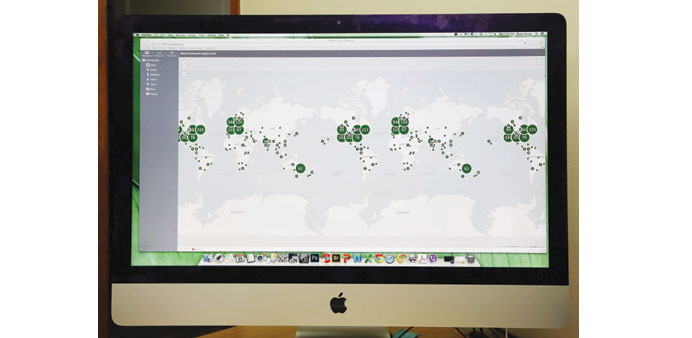
An image of MicroMappers