Reuters/London
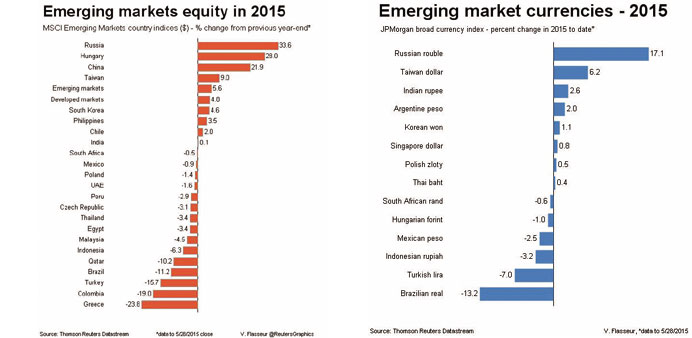
Emerging market shares fell yesterday and were on track to chalk up a monthly loss, weighed down by volatile China stocks, while currencies saw mixed fortunes on the day.
MSCI’s broad emerging market index traded 0.4% lower after China’s main bourses closed mixed following a rough ride earlier in the day.
There had been steep drops of more than 6% in the previous session, fueled by concerns over margin finance tightening moves and a flood of initial public offerings in coming days.
The Shanghai Composite index has risen more than 40% this year.
Russian stocks went against the grain, with dollar-denominated shares up more than 1%, buoyed by crude prices racking up similar gains while the dollar index slipped 0.13%.
The rouble traded 0.1% weaker against the dollar and the Turkish lira slipped 0.3%, while South Africa’s rand was flat.
“The fear of the Fed is restraining (global emerging markets) asset market performance and this should be the case until US monetary policy uncertainty is removed by the first rate hike,” Societe General wrote in a research note.
“After the Fed talks the plunge, the (emerging markets) backdrop could become more favourable.”
Fund flows over the past week reflected the recent bull run in Chinese stocks. Chinese equity funds saw inflows of $4.5bn - the largest since April 2008, according to Bank of America Merrill Lynch, citing EPFR Global data.
Emerging market equities racked up inflows of $4.1bn, the largest boost since July 2014, while emerging market debt funds recorded the first outflow in 10 weeks, Bank of America Merrill Lynch added.
In Ukraine, dollar-denominated bonds nudged up after Kiev said it had met almost all its targets for the International Monetary Fund to disburse a vital second tranche of credit and with more details of a creditors’ proposal on debt restructuring emerging.
The 2017, 2022 and 2023 issues gained between 0.25 and 0.67 cents - the first two rising for the third straight day.